Our Week in Reviews: 6/20/26
- June 20, 2026
A recap of the books we’ve spotlighted in the past few days.
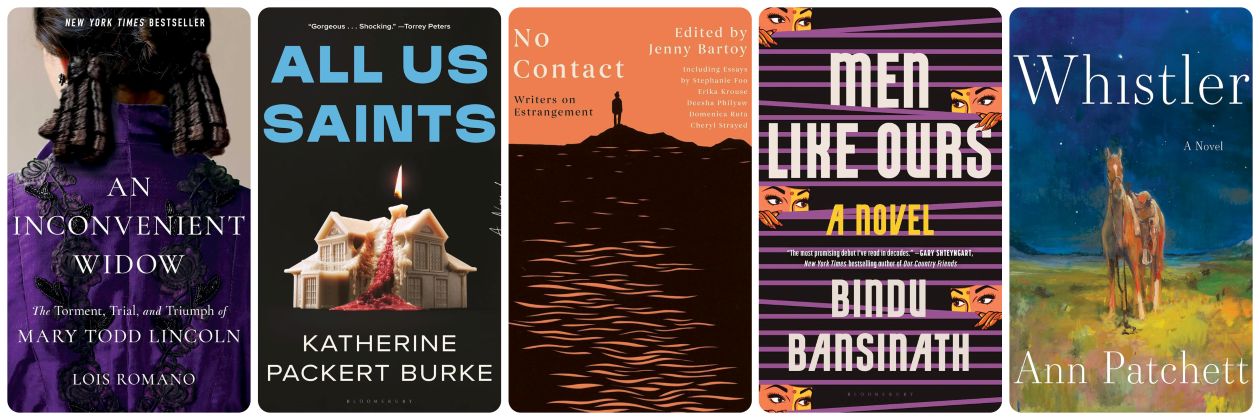
An Inconvenient Widow: The Torment, Trial, and Triumph of Mary Todd Lincoln by Lois Romano (Simon & Schuster). Reviewed by Justin H. Thompson. “Romano’s book presents a woman buffeted by history but unable to garner lasting sympathy. The author’s choice of the ‘inconvenient’ descriptor deftly defines much of Mary’s public persona, particularly in the aftermath of Lincoln’s assassination. The biography is vivid if uneven in its execution, attempting to rescue Mary from 150 years of invective while also revealing her to be ‘histrionic, self-focused, strong-willed, and impulsive, sometimes irrational, even dishonest at times.’”
All Us Saints: A Novel by Katherine Packert Burke (Bloomsbury Publishing). Reviewed by Marcie Geffner. “Katherine Packert Burke’s contemporary gothic novel, All Us Saints, portrays the tormented lives of four adult siblings almost two decades after three teenaged girls were killed inside their home. With a large cast of dramatis personae and a minimalistic plot, the author relies on a theatrical, locked-room structure, creepy images, and themes related to gender, sexuality, and violence to hold the story together.”
No Contact: Writers on Estrangement, edited by Jenny Bartoy (Catapult). Reviewed by Laura Fisher Kaiser. “The circumstances run the gamut from untreated mental illness and addiction to abandonment and (particularly within immigrant families) cultural alienation. Every scenario is heartbreaking, even in cases of existential threat. But once they go no-contact, there is little ambivalence. Indeed, there is clarity, although it doesn’t make things any easier.”
Men Like Ours: A Novel by Bindu Bansinath (Bloomsbury Publishing). Reviewed by Patricia S. Gormley. “While Bansinath alternates among many voices, the most important belong to women — both in the collective first-person-plural prologue and in the omniscient narrator’s relating of group conversations. That prologue is a master class in stage-setting: In it, the women describe the divisions and expectations in both gender and cultural norms. The titular men are hypocritical, lazy, careless, uninterested, and reliant on the women to do everything from keeping Desi culture alive to raising the children. It is visceral, cutting, and as sharply observed as anything by Jane Austen (if Austen had chosen to concern herself with oral sex).”
Whistler: A Novel by Ann Patchett (Harper). Reviewed by Ryan Davison. “As a sentimental examination of life and family, Whistler succeeds. Crisp prose and a halcyon plot driven by peaceful people exert the force of a steady breeze that never slams the shutters closed. Conflict and challenging situations very much exist here and are addressed head on — sometimes with resolution, but often (just like in real life) with acceptance. This is a contemplative book that will leave readers in a warm, speculative daydream.”
Don’t miss another excellent book review, author interview, or feature! Subscribe to our free newsletter and follow us on Instagram, Facebook, Pinterest, Bluesky, and Advertise with us here.