Men Like Ours: A Novel
- By Bindu Bansinath
- Bloomsbury Publishing
- 384 pp.
- Reviewed by Patricia S. Gormley
- June 18, 2026
A sharp, pitch-black thriller about culture and assimilation.
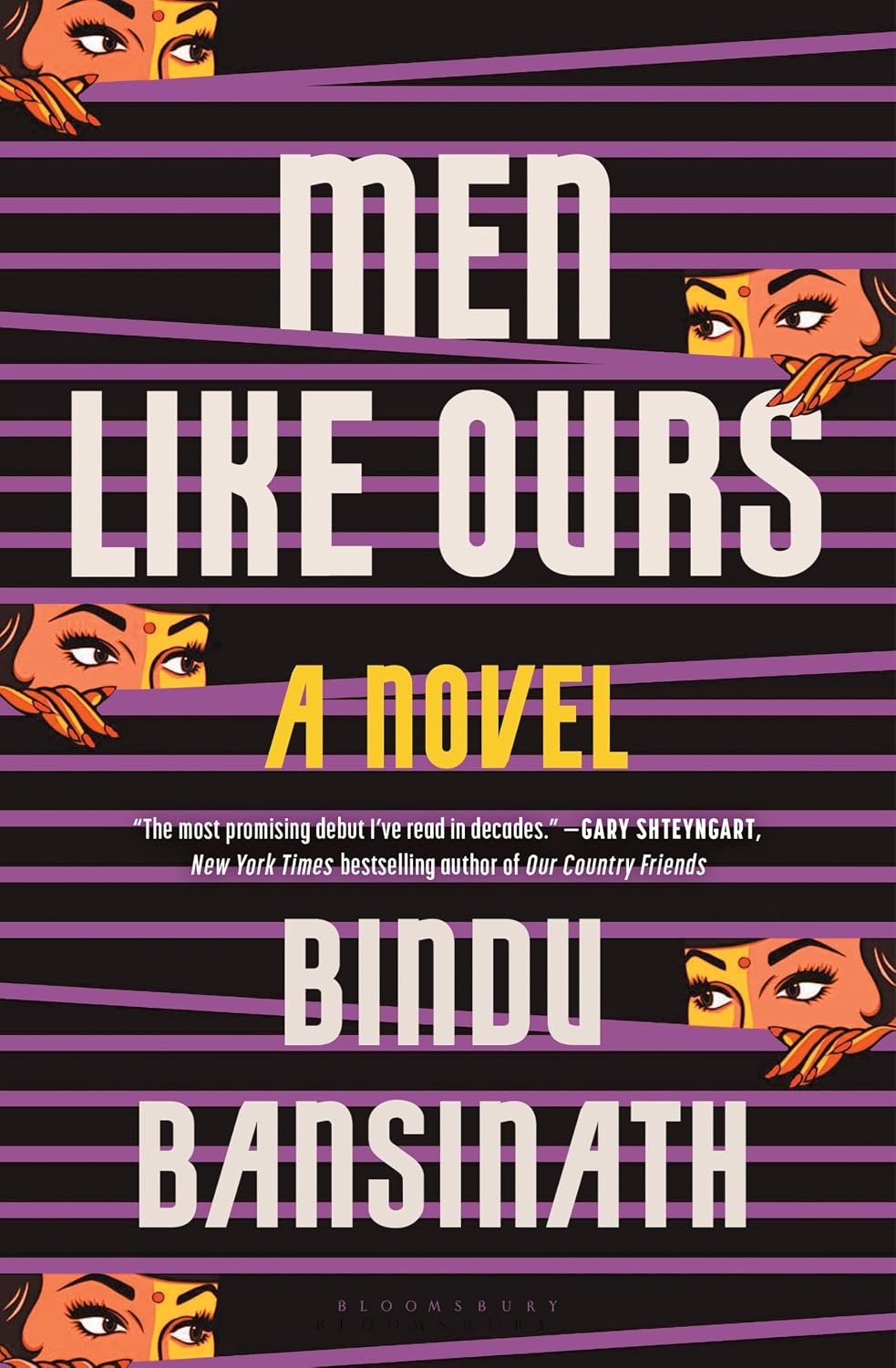
Conjuring a cul-de-sac with the thoroughly American name of Willow Road, in a New Jersey suburb known as Little India, author Bindu Bansinath weaves a tale that’s by turns delicate, brutish, cruel, humorous, and tragic.
The mysterious death of neighborhood fixture Matthew Pillai — and the subsequent investigation into it — forms the scaffolding of Men Like Ours, Bansinath’s decades-spanning debut novel. The Sharma family sits at the center of the investigation: Ashok, a meek and unambitious chemist; his much younger and bitter wife, Anita, who has a degree in software engineering; and their American-born daughter, Leila (described in the book’s index as “a tart”). Another significant character is Leila’s best friend, Riya (who’s definitely not a tart).
While Bansinath alternates among many voices, the most important belong to women — both in the collective first-person-plural prologue and in the omniscient narrator’s relating of group conversations. That prologue is a master class in stage-setting: In it, the women describe the divisions and expectations in both gender and cultural norms. The titular men are hypocritical, lazy, careless, uninterested, and reliant on the women to do everything from keeping Desi culture alive to raising the children. It is visceral, cutting, and as sharply observed as anything by Jane Austen (if Austen had chosen to concern herself with oral sex).
Whenever the narrative drops us in on the women, we see them discussing the events of the story with each other, which gradually fills in the pieces of the police inquiry:
“The officers collected the women’s testimonies, which came together slowly, part gossip and part fact, inconsistent as a stream of old frying oil.”
This piecemeal accumulation of details allows readers to consider different versions of the truth — “Of course that’s what happened” — giving us a critical advantage over the cops. We get to see the story taking shape, the pieces slotting into place. It’s an exceptional experience.
Naturally, since this tightknit community shares everything from recipes to chitchat about favorite TV shows, its trauma — and the subsequent competitive bickering over whose is worse — is also communal. Any child of immigrants is likely familiar with their elders’ tendency to portray their own sacrifices as having been so substantial as to render them immune from criticism, and the places where this phenomenon is pointed out are among the book’s funniest.
This is especially true whenever anyone argues with Anita: Eventually, each party insists they should die to end the suffering (presumably, of everyone). At one point, after a heated exchange, Anita disgustedly wipes “the smell of feet cheese from her forehead.”
Despite the humor, the novel is imbued with a sense of dread, an oily slickness. We see the missed communications, the bitterness, the assumptions, and the loneliness that allow predators and abusers to operate and the concerns of women to be dismissed. Even the police demonstrate racism and misogyny, which is infuriating but believable. It isn’t until the end that the women realize it’s up to them to repair the fissures.
The “men like ours” don’t show up as a collective point-of-view character until nearly a hundred pages in. When they finally arrive, they do little more than highlight their own hubris, asking:
“How could wives bear witness? What could they have seen, with their cartoonish sloe eyes, that the men had not seen better? Why was no-one questioning [us]?”
Of course, all along, the women do far more than merely bear witness to history. They speak it into being, preserving their culture and protecting its future in the process.
Patricia S. Gormley lives in Northern Virginia with her librarian husband and four small, mysterious beings who profess to be cats but who behave like permanently disgruntled toddlers with no verbal skills.