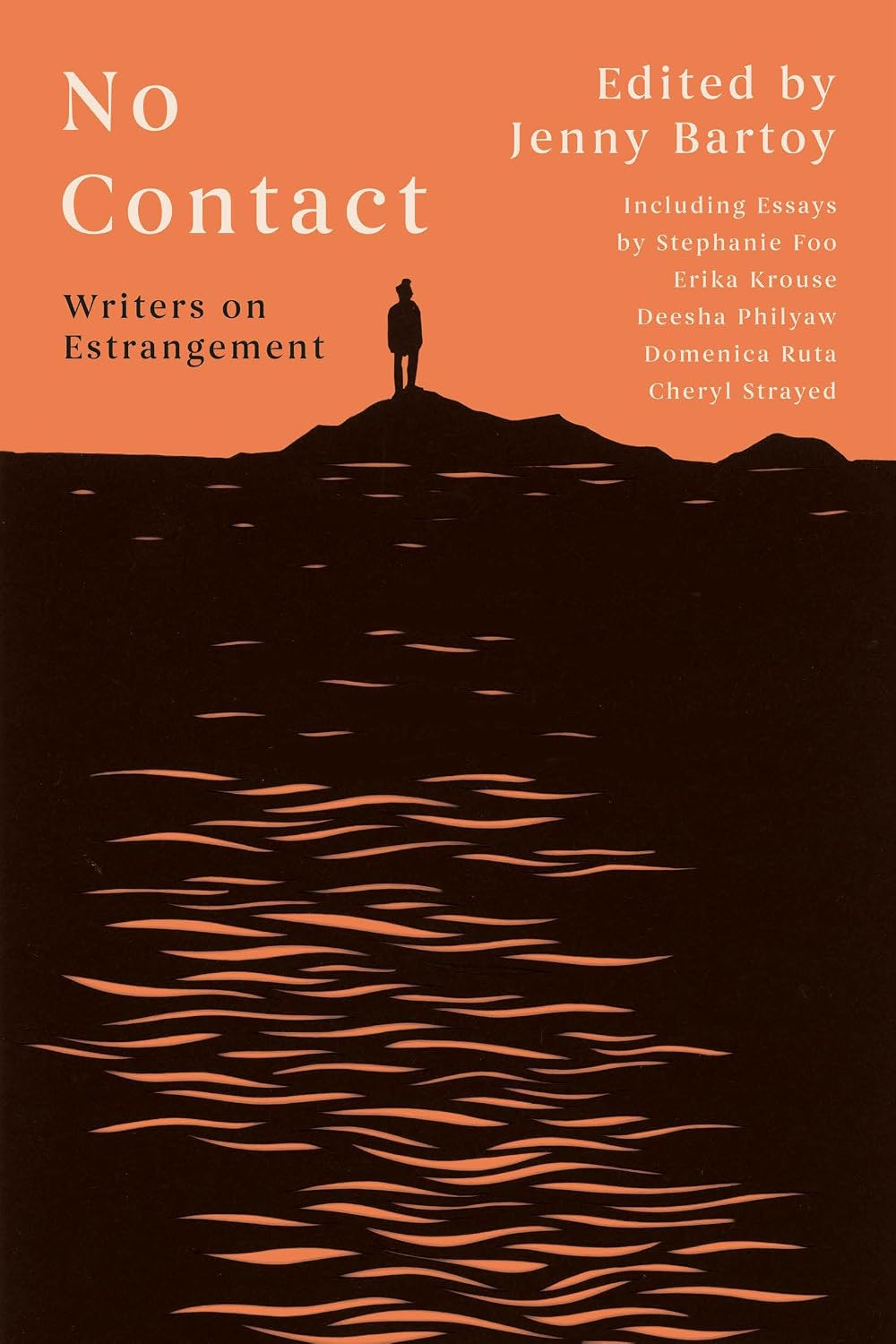
No Contact: Writers on Estrangement
- Edited by Jenny Bartoy
- Catapult
- 304 pp.
- Reviewed by Laura Fisher Kaiser
- June 17, 2026
When survival means saying, “You’re dead to me.”
Lately, I keep hearing about wrenching cases of family estrangement, even in my own extended one. Parents whose adult children have ghosted them. Brothers who no longer speak. Cousins divided by religious or political fanaticism. The pain on all sides, including among those caught in the middle, is palpable. Even if the aggrieved gives you a convincing earful, you come away with the same question, “How has it come to this?”
No Contact: Writers on Estrangement, an anthology edited by Jenny Bartoy, offers valuable perspective. In it, we hear from 32 writers, including Michelle Dowd, Stephanie Foo, Nick Flynn, and Cheryl Strayed, most of whom have initiated estrangement in one form or another. That is, they made the deliberate and difficult decision to erect an invisible, deadening wall between themselves and a relative who treated them abominably.
The circumstances run the gamut from untreated mental illness and addiction to abandonment and (particularly within immigrant families) cultural alienation. Every scenario is heartbreaking, even in cases of existential threat. But once they go no-contact, there is little ambivalence. Indeed, there is clarity, although it doesn’t make things any easier.
What family has not had its share of Tolstoyan unhappiness? You might hear about some relatives who’ve “gotten into a snit,” as my mother would say, forcing everyone else to walk on eggshells. Or siblings who’ve been waging the same battle since childhood. Family tiffs have existed since ancient times, but sometimes they serve as proxy wars for deeper transgressions that nobody dares name (e.g., abuse, mindfuckery, money, religiosity, etc.). When those problems go unresolved, they become a tinderbox.
None of the writers in this book have gone scorched-earth on a whim. Their weighty decisions come as a last resort, often after years of abuse or betrayal (often at the hands of parents). Judging from this curation, there are a lot of people out there who have absolutely no business procreating. They’re not just crappy parents, they’re monsters. Even so, eradicating them from one’s life can feel unnatural. As Bartoy asks in her introduction:
“Who are we without our family? What kind of person cuts the proverbial umbilical cord and why? And who do we become once separated from our kin?”
Yet, when each of these narrators found themselves at a perilous tipping point, the only way to maintain their dignity and sanity was to cut ties completely and irrevocably. Part of the process entails — presumably with the help of a therapist — learning to identify and name toxic behaviors and stop normalizing them.
In this genre, pop-psychology jargon is almost unavoidable, but the writers here keep it real, deploying clinical phrases just enough to be useful to readers struggling with their own predicaments. A couple of entries could stand to be shorter, but that’s a delicate task for any editor, and even more so with such soul-baring material. It would be like your therapist cueing the Oscar-playoff music.
I applaud Bartoy’s decision to intersperse first-person essays with occasional poetry and experimental pieces. The poems do some impressive heavy lifting, processing trauma without sugarcoating it. “Episodic Tremor and Slip,” Lorne Daniel’s five-stanza tearjerker about a son’s battle with drugs, begins with an epigram by Ralph Waldo Emerson:
“We learn geology the morning after the earthquake.”
Indeed, some families have no idea they’re straddling a San Andreas-size fault until the Big One strikes. I struggled at first with the odd syntax of Gabriella Denise Frank’s “ESTR NGEMENT” until I read her author’s note, which explains that it’s a lipogram, a literary constraint that excludes one or more letters. Go back, read again, and sure enough, she has managed to write an entire essay without using the letter “A,” an exercise that conveys “what’s estranged for me: father, dad, and family.” The form becomes the message.
Estrangement is a conscious rupture of family bonds. It requires tremendous resolve to keep it up, especially if the relative refuses to acknowledge the new terms or is incapable of doing so, or if duty calls. In Soni Brown’s poignant “Wash Belly,” the narrator realizes she has become a stranger to her native culture in Jamaica while caring for her mother, who has Alzheimer’s and has become a stranger to herself.
I found “Together” by native Washingtonian Mattilda Bernstein Sycamore particularly jarring. The writer recalls returning to DC to promote her memoir, Touching the Art, about her relationship with her grandmother, an abstract artist. But as Sycamore is walking to Politics and Prose Bookstore to give a reading — a coup for any author — she finds herself bombarded by painful flashbacks to her father’s sexual abuse of her as a child. Thinking about the other adults in her orbit who failed to acknowledge the horror hiding in plain sight, she feels gutted by a fresh sense of betrayal. The reader, too, is prompted to reflect on the role of bystanders or, more accurately, their own role in the concatenations that lead to estrangement.
There is always, of course, another side to the story. “Dichotomy of the Rejected” by Geneva Phillips tells what it’s like to be the one iced out. She lost custody of her young children because of her own substance abuse and incarceration. More than a decade later, she’s still trying to make sense of it all — her mistakes, her remorse, her yearning to see her grown babies. “‘Why’ is equivalent to running circles on a sheet of nails,” she says. She’s learned to compartmentalize her pain, and one senses that she hopes her children, wherever they are, read her essay so they can know she understands why they want nothing to do with her. Her reckoning feels relentless, and she acknowledges that she’ll probably never hear from them again. “And yet,” she writes, “and yet.”
That Bartoy chose Phillips as one of her closers speaks to the human tragedy contained in these pages. After reading so many variations on the theme, we don’t have to hear from Phillips’ children to comprehend their reasons. Because family estrangement so defies the natural order, it follows that everyone affected — the aggrieved, the ghosted, and everybody on the sidelines — prays for some kind of rapprochement.
It can happen. I’ve known family members to bury the hatchet, much to everyone’s relief. But as this nuanced collection makes abundantly clear, severing all connection can sometimes be the healthiest choice of all.
Laura Fisher Kaiser lives in Washington, DC, and is writing a biography of “lost lady of lit” Elizabeth Dejeans (1868-1928), who was also her lost cousin because of family estrangement.