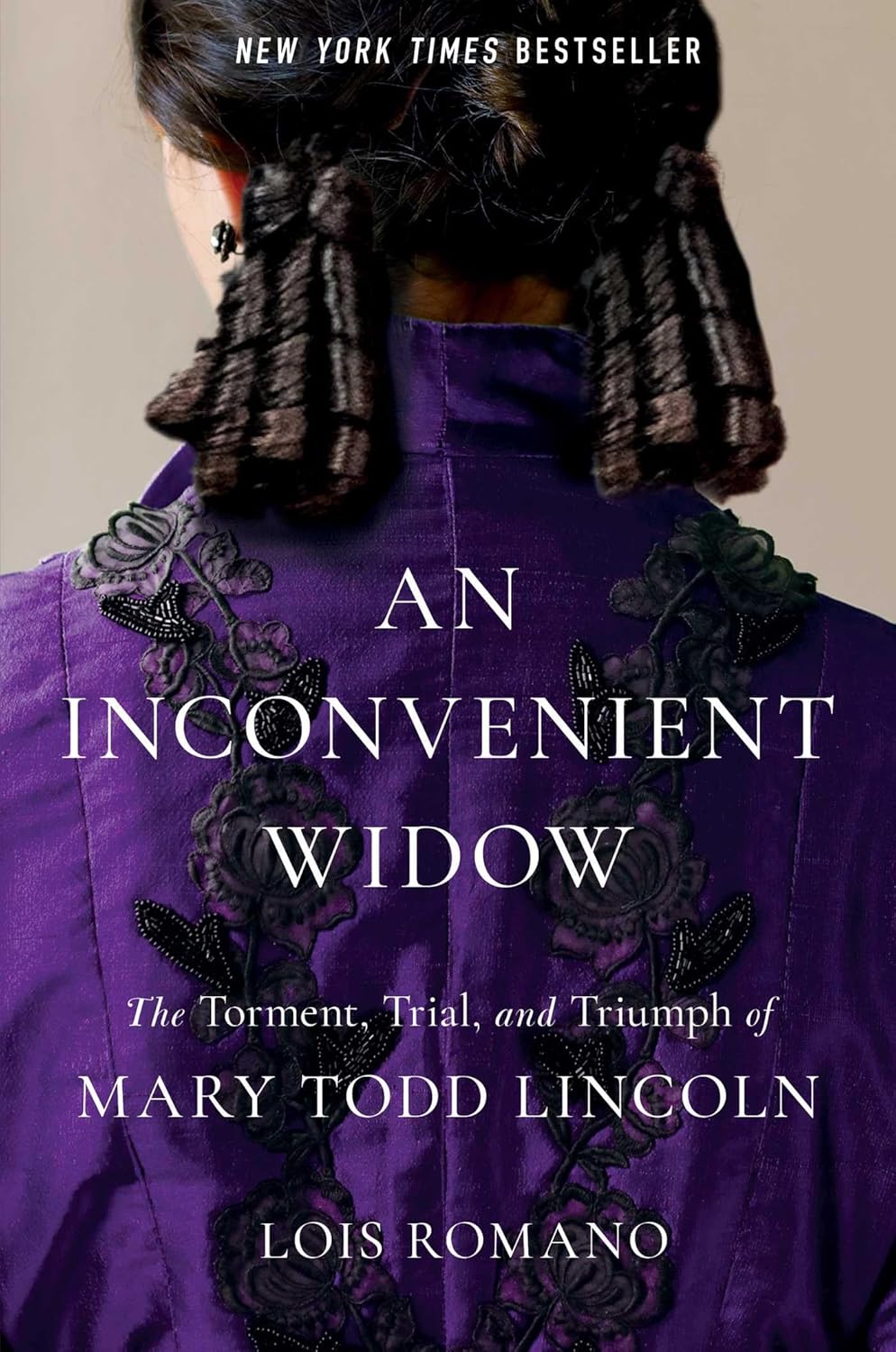
An Inconvenient Widow: The Torment, Trial, and Triumph of Mary Todd Lincoln
- By Lois Romano
- Simon & Schuster
- 480 pp.
- Reviewed by Justin H. Thompson
- June 15, 2026
The famously volatile figure is cast in a sympathetic light.
Mary Todd Lincoln is having a revival. Thanks to the Tony Award-winning play “Oh, Mary!” Mrs. Lincoln has been embodied by famous names in New York and London. Its author and sometimes star, Cole Escola, has coyly denied doing any preparation for his role, summarizing the premise of the show with a wink and a nod. “If you didn’t know,” Escola explained during one interview while in costume, Mary “was Abraham Lincoln’s wife.” Then, leaning into the punchline, they added, “He had one of those.”
The entire show revels in the former first lady’s unwitting modern status as a gay icon, portraying her as an alcoholic who longs to perform. Mary — once dismissed as the emotional albatross of our greatest president — is now camp. The show is factually baseless but aesthetically seizes on the characteristics that made the woman both charming and despised.
As Lois Romano summarizes in An Inconvenient Widow, her new biography of Mary Todd Lincoln, “She was a larger-than-life, provocative character who spent too freely, grieved too publicly and for too long, and seemed unable or unwilling to corral her emotions, her temper, and her opinions.” No wonder she continues to attract imitation and interpretation.
Romano’s book presents a woman buffeted by history but unable to garner lasting sympathy. The author’s choice of the “inconvenient” descriptor deftly defines much of Mary’s public persona, particularly in the aftermath of Lincoln’s assassination. The biography is vivid if uneven in its execution, attempting to rescue Mary from 150 years of invective while also revealing her to be “histrionic, self-focused, strong-willed, and impulsive, sometimes irrational, even dishonest at times.”
To be blunt, the Mary Todd Lincoln of this biography is sometimes unlikable. Yet, she was also subject to forces she could not hope to overcome. Mary was “too needy [and] too ready to lash out,” writes Romano, which makes it difficult to disentangle the patriarchal and sexist characterizations from those that are more reasonable. While she was, after Lincoln’s death, at the financial mercy of others, when Mary finally received a portion of her late husband’s salary — $22,000 after taxes — she immediately bought a house in Chicago. Within a year, she was unable to support herself and was forced to rent out the home and auction the furniture.
Another writer might’ve worked to more fully unravel those overlapping and intersecting threads — the cultural and the personal — but Romano tends to err on the side of Mary. In the face of decades of withering historiography, Romano’s protectiveness of her subject and recuperative aims are admirable, but they ultimately continue to paint a skewed portrait of a complicated human being.
Similarly, Romano too often declares Mary’s motivations without enough basis in fact. Even when there is ample historical evidence, it’s impossible to truly know the internal state of a given figure. Near the end of the Civil War, for example, the Lincolns and their son Tad visit General Ulysses S. Grant outside Richmond, the Confederate Capitol. When “the young spirited wife” of another general is permitted to ride next to Lincoln while Mary and Grant’s wife follow in a carriage, Mary responds with “inexplicable rage,” yelling at the woman when she stops to pay her respects to the president’s wife. “[A]s was often the case with Mary,” Romano aptly writes, “a swirl of emotions lay beneath the surface.”
But then the biographer pushes past what we are able to know, adding, “She derived her confidence from always being by her husband’s side in public situations. When she felt diminished, she was prone to lashing out. Her need for control, for status, was stronger than her need for approval.”
It is a charge Romano herself directs at William Herndon, Lincoln’s one-time law partner and an ongoing, sometimes quite public, opponent of Mary. In one of the talks Herndon gave about Lincoln’s life, he describes the commander-in-chief’s mental breakdown in 1841 as coming from the dread of spending a life with Mary that he termed Lincoln’s “nightmare,” a sentiment, Romano retorts, “which [Herndon] had no way of knowing.”
Still, An Inconvenient Widow is entertaining and informative, bookended by detailed descriptions of Mary’s “insanity trial” in 1875. Here, Romano’s rehabilitative approach is justified. Weaving together the broad and the specific, she writes:
“Mary’s three-hour trial had all the stereotypical overtones of the era: the misogynistic view of women as the weaker, more hysterical, and less intelligent sex, coupled with a lack of knowledge about mental health.”
The proceedings included testimony from hotel clerks and shopkeepers, though the main witness was Mary’s only surviving son, Robert. The jury didn’t spend much time deliberating, and Mary was ordered to an asylum outside Chicago. That she allegedly attempted to buy lethal doses of laudanum that same evening only seemed to confirm the charges against her. She would spend the rest of her life rootless and under a perpetual microscope.
At the Smithsonian’s National Museum of American History in Washington, DC, there’s an exhibit of clothing worn by first ladies. The garments are material reminders that these were real people who lived, experienced the world, and left their names to posterity. Mary’s purple velvet ensemble with white satin trim and mother-of-pearl buttons was likely made by Elizabeth Keckley, a formerly enslaved woman who became one of Mary’s closest confidantes.
For playwright Escola and countless others, Mary is like the gown: merely a vehicle for performance, a persona to inhabit. Where Romano succeeds in An Inconvenient Widow is by revealing a charming, maddening woman who seemed to lose a bit more of herself after each personal tragedy. It’s a testament to Romano’s corralling of a vast life into a readable volume that Mary Todd Lincoln, in all her complexity, still reads as a tragic figure worthy of historical reconsideration and maybe a little grace.
Justin H. Thompson studied English literature. He lives and works in Washington, DC.