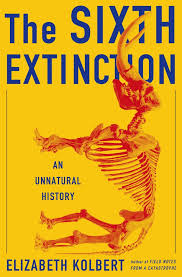
The Biographer’s Quest
- By Jeffrey Meyers
- Mercer University Press
- 256 pp.
- Reviewed by Kitty Kelley
- July 20, 2026
An author reflects on his decades spent chronicling others’ lives.
Book reviews rarely begin with a mention of the author’s photo, but an exception is being made for Jeffrey Meyers’ The Biographer’s Quest because his photo seems to carry the key to his book’s message. On the back fly page, where most authors share a standard portrait and an abbreviated bio, Meyers instead presents a painting of himself dressed up like Sydney Greenstreet in “Casablanca.”
Yes, it seems bizarre for the 87-year-old author to identify with the crooked night-club owner visiting Rick’s Café, but there sits Meyers alongside a bottle of Jack Daniels. A dead ringer for Greenstreet as Signor Ferrari, he sports a white dinner jacket and a tasseled red fez. In the background is Humphrey Bogart.
One can’t be absolutely sure, but this appears to be Meyers’ way of introducing the professional shift he made years ago from writing “literary biographies” to advance his academic career to penning commercial ones to support his family.
A tenured professor for decades, Meyers has written 58 nonfiction books, including lofty tomes on Katherine Mansfield, Wyndham Lewis, Edmund Wilson, and George Orwell. When he left academia to become a full-time writer, he found “writing to earn a living, as opposed to writing and research as part of the job at a university, presented challenges I had not anticipated.” At that point, he pivoted. He searched for a subject who would sell, one who would appeal to a wide audience, not simply to a limited field of scholars.
Meyers wanted someone universally known, whose work he admired, and “whose character was intriguing enough to arouse my interest and hold my attention.” So he chose Bogart as his launchpad, since, as he notes earlier in the book, “two essential elements of biography are sex and death.” Meyers says he found all that and more in Bogart, just as he had in writing about Ernest Hemingway. Both had domineering mothers, carousing lifestyles, multiple divorces, and public personas that enriched each man with immense worldly success. “Both acted out in real life the persona — Bogie and Papa — they had established in their art.”
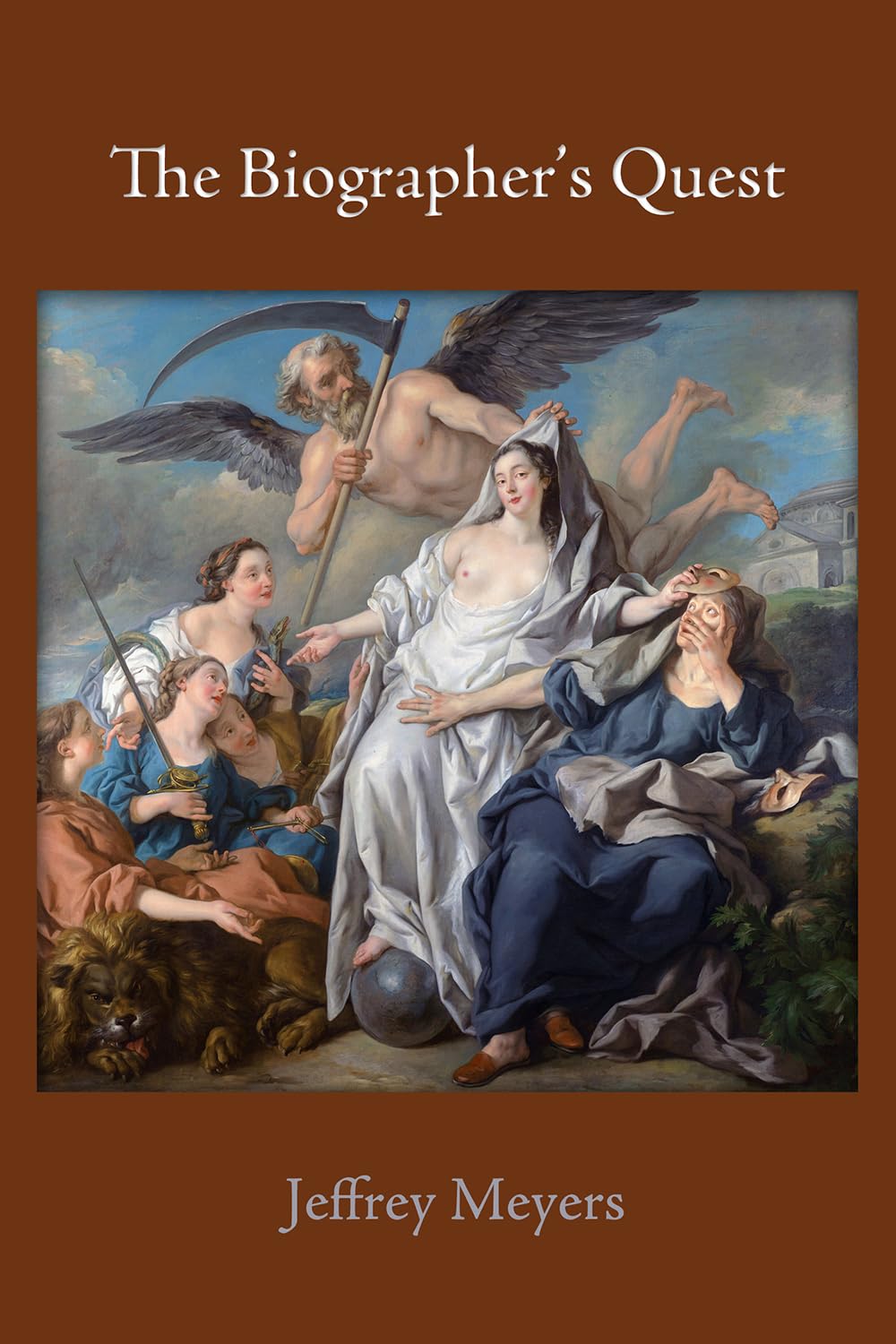
Moving from the author’s photo to the cover of The Biographer’s Quest, the old adage that a picture is worth a thousand words is again proven true. Here, Meyers uses an 18th-century painting by Jean-François de Troy entitled “Time unveiling Truth,” which depicts Father Time, grey-bearded and carrying a long scythe, as he swoops down on huge wings to lift the veil of Truth, who herself unmasks Deceit, while maidens representing the four cardinal virtues — prudence, temperance, justice, and fortitude — look on. In choosing this image, Meyers has artfully conveyed his message about writing biographies: Tell the truth.
His book is an erudite tour of his experiences writing life stories. His best advice to those hoping to follow in his footsteps is contained in his “Twelve Principles of Literary Biography,” which stand as a good primer for anyone venturing into the genre:
- Read everything in print and follow up every lead.
- Be persistent and see everyone who will talk to you.
- Weigh all the evidence like a lawyer: a biographer is “an artist on oath.”
- Get the subject born in the first five pages; nothing is more boring than genealogy.
- Describe the subject’s personal habits and tastes.
- Portray the friends and minor characters as fully as possible.
- Don’t focus on the facts of the life, but on what they mean.
- Look at the big picture, not the small details, and illuminate the recurrent patterns of the life.
- Keep up the dramatic narrative, employ the same techniques as the novelist and concentrate on the reader’s interest rather than on your own obsessions.
- Be selective rather than exhaustive, analytical rather than descriptive.
- Complete the book in a few years or you will begin to hate the subject for eating up your life.
- Always remember the responsibility of the biographer to do justice to the subject.
Meyers seems to have concentrated most of his time writing about men. Of them, he recalls:
“All the writers and actors left a trail of emotional wreckage, and their families revealed their private struggles as husbands and fathers…Most of these brilliant but self-absorbed men had a cruel streak and were pretty poor husbands and fathers. They had several wives and lovers, and were often distant from and critical of their children.”
Here, the professor has opened unexplored territory for future biographers: Pursuing the lives and times of the women who paid the price for men’s success and laying their truths bare. Sounds like fertile ground. So many wives, lovers, and mistresses. So little time.
Kitty Kelley is the author of seven number-one New York Times bestseller biographies, including Nancy Reagan, Jackie Oh!, and Elizabeth Taylor: The Last Star. She is on the board of the Independent and is a recipient of the PEN Oakland/Gary Webb Anti-Censorship Award. In 2023, she was honored with the Biographers International Organization’s BIO Award, which is given annually to a writer who has made major contributions to the advancement of the art and craft of biography.