Our Week in Reviews: 6/13/26
- June 13, 2026
A recap of the books we’ve spotlighted in the past few days.
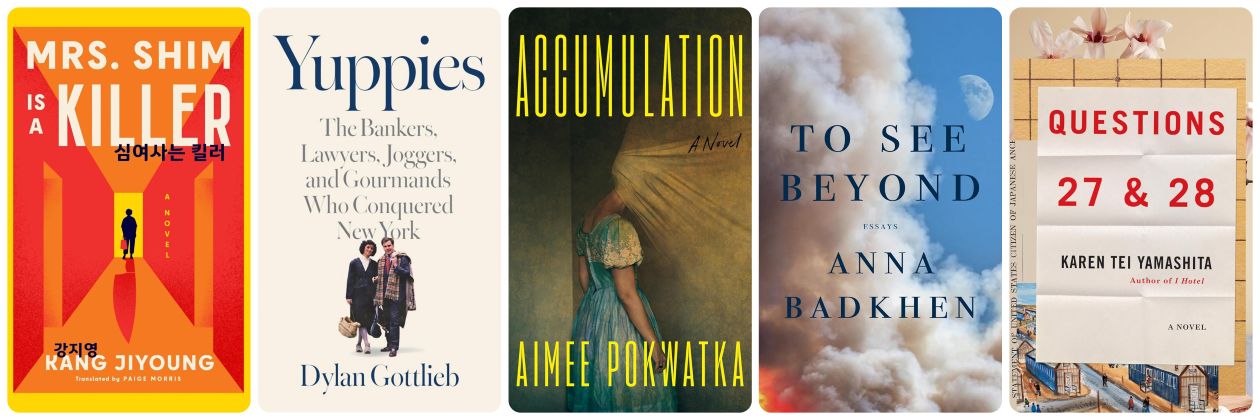
Mrs. Shim Is a Killer: A Novel by Kang Jiyoung; translated by Paige Morris (Harper Perennial). Reviewed by Alice Stephens. As it happens, the world of Seoul contract killers is a small, incestuous one. They operate from one of two rival detective agencies: Smile and Happy. Smile dominated the market due to Mr. Park’s legendary knife skills, but when he stopped killing, Happy took over as number one. Then, dead bodies start piling up, and residents begin to worry about a serial killer. At Happy Detective Agency, there’s talk that Mr. Park has a new, ruthlessly efficient employee. They call her the Ajumma Killer and wonder who she could possibly be.
Yuppies: The Bankers, Lawyers, Joggers, and Gourmands Who Conquered New York by Dylan Gottlieb (Harvard University Press). Reviewed by William Rice. “Readers seeking lighthearted nostalgia about shoulder pads and suspenders should look elsewhere. This book is an indictment, and the charges include murder: Deadly fires were used to dislodge working-class, usually Black or Latino families from rent-controlled buildings that could be rented or sold at market rates to yuppies. The author chillingly reports that between 1978 and 1983, in nearby Hoboken, New Jersey — just across the Hudson River from Midtown Manhattan — arson ‘killed fifty-six people and left more than eight thousand homeless.’”
Accumulation: A Novel by Aimee Pokwatka (G.P. Putnam’s Sons). Reviewed by Sarah M. Lawrence. “Tenn and her family — husband Ward and children Aisling and Anders — have just moved from North Carolina to New York for Ward’s new high-paying, serious job. As a token of love, he buys his wife her dream house. But as they settle in, weird things begin occurring: A random doll appears in the yard, the faucet keeps turning on, and the kids act strangely.”
To See Beyond: Essays by Anna Badkhen (Bellevue Literary Press). Reviewed by Sara Polsky. “Her essays call for a widening of the scales at which we think about seemingly contemporary problems. They are global, ancient, and impactful beyond regional or national boundaries, and solving them will require a return to — or a renewed awareness of — traditional practices and forgotten folklore. For Badkhen, who was raised outside of faith, that has even come to include prayer, which can ‘extend ourselves outside of our dailyness, to restructure our seeing and listening.’”
Questions 27 & 28: A Novel by Karen Tei Yamashita (Graywolf Press). Reviewed by David A. Taylor. “The narrative in Questions 27 & 28 centers on the period from 1942 through 1945, after President Franklin D. Roosevelt signed a WWII executive order authorizing the uprooting of roughly 120,000 Japanese Americans from their homes on the West Coast and detention in an archipelago of hastily built camps. (For generations, these were called ‘internment camps’; many now consider ‘concentration camps’ more accurate.) The story reaches backward and forward across decades, but to call it a novel about the camps is like saying Ulysses is a novel about a day in British-held Dublin.”
Don’t miss another excellent book review, author interview, or feature! Subscribe to our free newsletter and follow us on Instagram, Facebook, Pinterest, Bluesky, and LinkedIn. Advertise with us here.