To See Beyond: Essays
- By Anna Badkhen
- Bellevue Literary Press
- 192 pp.
- Reviewed by Sara Polsky
- June 11, 2026
An expansive consideration of who we are and what we stand to lose.
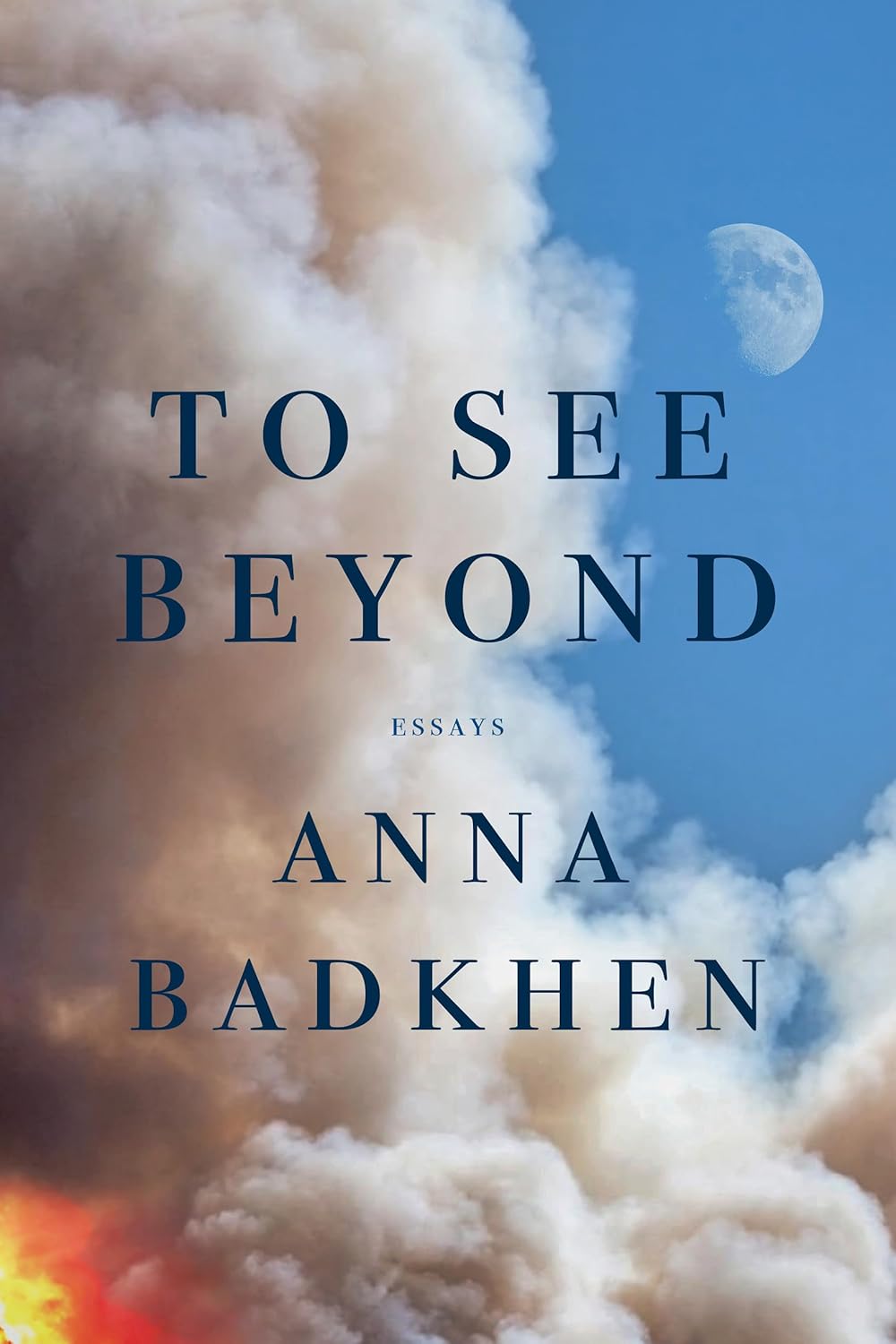
The first sentence of Anna Badkhen’s To See Beyond is a stark question: “Seeing beauty amid depravity seems a tall order, but how else will we survive our own history of violence?” Her essay collection is peppered with similarly urgent queries and declarations, all meant to call our attention back to each other and to the natural world.
In a recent interview with Publishers Weekly, Badkhen, a former journalist, described the mandate of her current role — a writer rather than a reporter — as “to see beyond the facts” into the realm of things that can’t be verified. In the collection’s first essay, “Our Years of Magical Thinking,” she accompanies a friend to a market in Bamako, Mali, to look for the lion fat that he believes will help his arthritis, a journey that detours into Badkhen’s own herbalist memories from her childhood in Russia. Her friend tells her that “there is a cure for almost anything, you just have to know how to ask.” Badkhen feels, when it comes to both herbal remedies and retaining human decency, that we’ve forgotten how and what to ask.
Her essays call for a widening of the scales at which we think about seemingly contemporary problems. They are global, ancient, and impactful beyond regional or national boundaries, and solving them will require a return to — or a renewed awareness of — traditional practices and forgotten folklore. For Badkhen, who was raised outside of faith, that has even come to include prayer, which can “extend ourselves outside of our dailyness, to restructure our seeing and listening.”
Changing our perspective can also involve reconnecting with the past, as the author does in “Mythologizing Disaster,” when she visits Auschwitz, or in “Souvenirs of Climate Catastrophe,” in which she describes the hunger stones of Central Europe. These are “river boulders that people living through droughts petroglyphed with dates and descriptions of their woe,” including scarcity, dryness, and starvation. (Greenpeace left its own modern version of a hunger stone in August 2018.) Badkhen’s virtuosic shifting of scales throughout the book gives readers many routes for connecting with her ideas, many ways of “hold[ing] on to something that astonishes.”
For me, the quotations from hunger stones were especially affecting, but other readers might find resonance in Badkhen’s emphasis on nature’s long-term memory. In “Portholes,” she notes that even after buffalo had been mostly eliminated from the wild in the United States, “the land still holds buffalo memory,” and the animals’ wallows “still maintain, for more than a hundred years, ecosystems that differ from the surrounding landscapes.” Like the hunger stones, these ecosystems have messages for us.
Badkhen is also preoccupied with language on a minute scale, particularly the language we find or create to describe indescribable things. In “How to Discuss the Death of Giants,” she wonders whether we need to rename species that no longer populate their traditional habitats due to climate change. “What are the words to express a world circumscribed by climate catastrophe?” she asks.
And when writing about mass violence, she wonders how, given our limited vocabulary, “we avoid creating shorthand for suffering greater than a heart should fathom.” These are questions unanswerable in a single essay collection, but Badkhen’s asking — and her roving through the multiple languages she speaks in search of approaches to them — opens up the possibility of future answers.
Much of her family was born in St. Petersburg, but many relatives are now “dislocated, déplacé,” she writes in “An Anatomy of Lostness.” She ranges geographically as much as linguistically, and while she writes that she frequently forgets her own economic-migrant status because she doesn’t “fit the stereotype...it has infected me, too, dislocated my sense of reality.” This sense of dislocation seems productive, allowing her to make connections across topics that might box in other writers.
Amid Badkhen’s big-picture questions are small episodes of extraordinary beauty: a moment in a shared taxi from Dakar, Senegal, when she and her fellow passengers regard “a large herd of fat white zebus [that] sways through spiky grass.” Or her description of amber (in a sentence that mirrors the book’s ability to encompass geological time) as “almost sentient, only a wand flick away from being able to speak and tell us all it knows — advents and vanishings of plants and animals, human and nonhuman, and of water, and of land, and even of the soil and rock that make up land.”
The author is herself an amber-like ambassador, one who understands that letting in the vastness of what we face might be the only way to face it.
Sara Polsky is a writer, editor, and educator based in New York City. She is the author of the YA novel This Is How I Find Her.