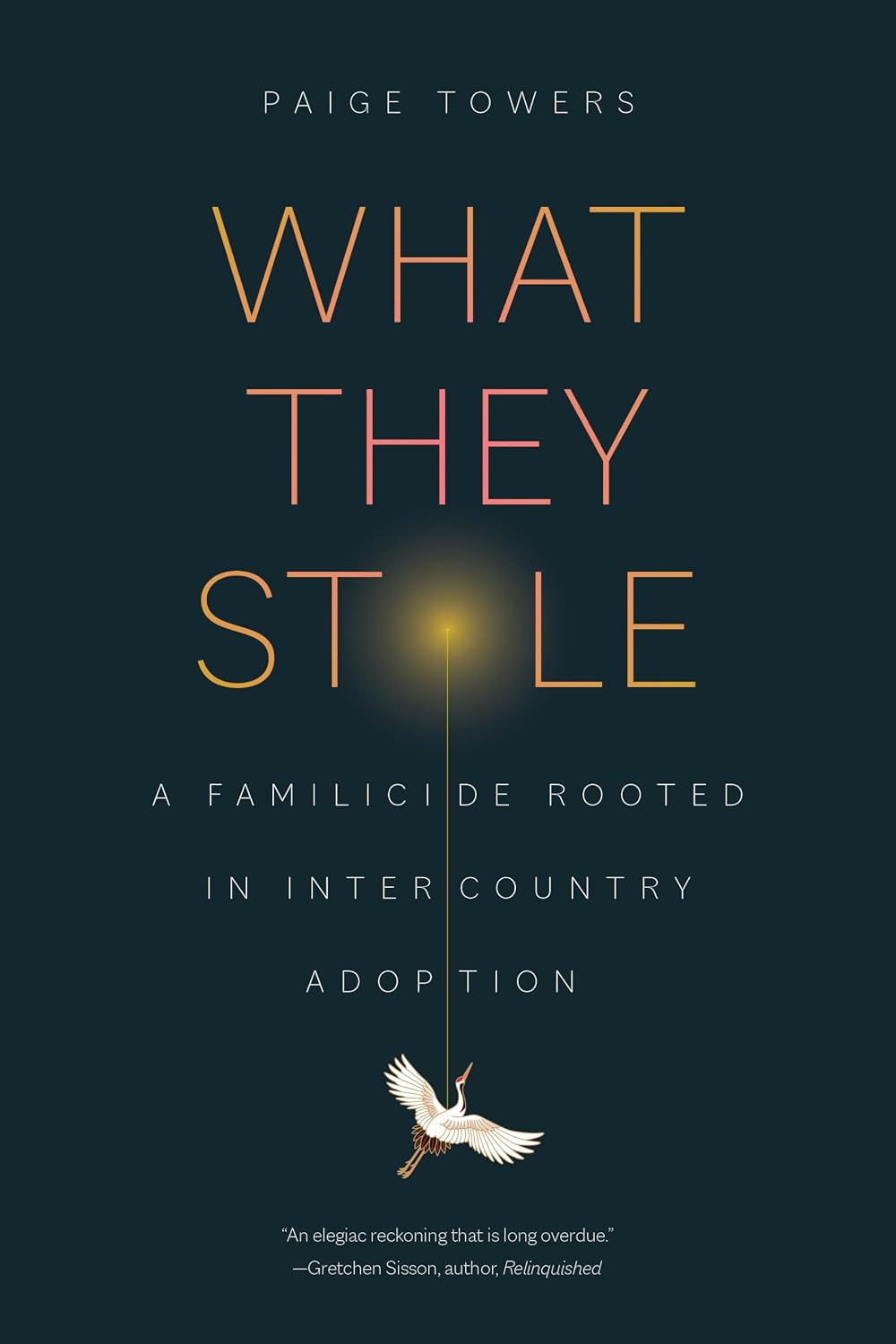
What They Stole: A Familicide Rooted in Intercountry Adoption
- By Paige Towers
- University of Iowa Press
- 364 pp.
- Reviewed by Alice Stephens
- July 7, 2026
A brutal crime reveals the rot inside the Holt adoption agency.
Since its inception, Korean adoption has been marketed as a heartwarming, humanitarian way to build a family by giving starving orphans a better life — and, for some Christians, to save souls. Korean adoptees and scholars have long been working against this narrative to present a more nuanced view. However, it’s only in recent years that the full truth behind Korean adoption has seeped into the mainstream.
Even South Korea’s government is finally acknowledging the widespread fraud and abuses of its adoption policy. I was one of 56 adoptees whose adoptions South Korea’s Truth and Reconciliation Commission found to be in violation of human rights. After the first investigation was abruptly closed in 2025, the commission has since extended it.
The most prolific adoption agency by far was founded by American Evangelicals Harry and Bertha Holt. While their role in intercountry adoption has been examined by adoption-studies scholars, and many cases of fraudulent practices and unqualified adoptive parents have come to light, Paige Towers’ investigation of the Holts’ program, What They Stole: A Familicide Rooted in Intercountry Adoption, brings the receipts, and they are horrific and damning.
The book is ostensibly about a 2008 murder-suicide by Steve Sueppel of his wife and four children. A pillar of the community, Steve was an Iowa City bank executive married to Sheryl, who gave up her job as an elementary-school teacher to raise the kids they adopted from South Korea through Holt International, an agency originally established as the Holt Adoption Program in the 1950s. Starting in 1998, the Sueppels added four South Koreans to their family, naming them Ethan, Seth, Mira, and Eleanor.
But this is really a story of two families who adopted multiple Korean children: the Sueppels and the Holts. Burying the lede, the author devotes most of the book to Harry and Bertha Holt, first cousins who married, had six children of their own, and then adopted eight more from South Korea while founding the largest intercountry adoption agency in history.
Harry Holt made his fortune logging the trees from a property he bought in Oregon’s Willamette Valley. In 1955, after the family sponsored Korean War orphans through World Vision, a Christian humanitarian organization, Harry decided to adopt eight “GI children,” the mixed-race offspring of Korean women and American soldiers. At that time, federal law only permitted a family to adopt two children from overseas, so the Holts allied with Richard L. Neuberger, a Democratic U.S. senator from Oregon. Writes Towers:
“Where some people saw a complex web of ethical issues, Senator Neuberger saw starving children; he skipped all the standardized steps for evaluating potential adoptive parents…Neuberger wrote the ‘Holt Bill’ himself — the act that would allow Bertha and Harry to adopt six more children than legally permitted.”
Despite alarms raised by Oregon’s Child Welfare Division, which found that the Holts’ “basic motive for adoption appears to be a missionary one,” Harry left for South Korea to search for the right orphans: half-white, starving, and sickly.
South Korea at that time was under the rule of American-backed authoritarian president Syngman Rhee, whom novelist Pearl S. Buck reported as saying mixed-race children should be “removed from Korea ‘even if we have to drop them in the Pacific Ocean.’” South Korean culture prizes purity of blood, and mixed-race children were seen as a scourge and a reminder of the country’s continued colonialization. Harry Holt offered a perfect solution that not only rid it of an unwanted population but also earned much-needed foreign currency while currying favor with the U.S.
But first, the Holts had to come up with a way to accommodate Korean and American adoption and immigration laws. And, thus, the original sin of intercountry adoption was introduced. The author explains:
“Under Harry’s pioneering plan, he’d serve as the initial adopter — the proxy agent. Later, the adoptive parents would pick up their ‘mail-order baby,’ as the US press deemed them, sight unseen, from a stateside airport. ‘And he did this,’ as [a] Daily News reporter wrote, so that ‘Korean children could be adopted by Americans under Korean law. He did this to circumvent the lengthy U.S. adoption procedures.’”
Proxy law allowed Americans to give the Holts power-of-attorney to adopt Korean children in their name and bring them to the U.S. as their own, evading state child-welfare laws and allowing adoptive parents to go unscreened by anyone but the Holts, whose only criterion was that the adopters be Evangelical Christians (although, later, adoptions by parents of other faiths were allowed).
People in the adoptee community have long known from witness testimony that Holt adopters were inadequately vetted, and Towers presents the evidence, citing news articles, academic studies, social-work reports, and personal interviews of Korean adoptees who were criminally mistreated and abused — and, sometimes, murdered. She also recounts the stories of Holt’s own adopted children and their challenging lives.
Eventually, the Holts established their own orphanages in South Korea and went to great lengths to fill them. The author describes the wanton taking of mixed-race children by Holt and his henchmen, quoting Bertha and Harry as bluntly referring to “hunting” and “collecting” kids. They aggressively hounded mothers, even snatching children from their yards. Towers meticulously documents the appalling conditions of Holt orphanages; the neglect suffered by children under their care; the cavalier way they were transported to the U.S. and dealt out to waiting families at the airport; and abuse in adoptive families.
As demand for Korean “orphans” grew, the Holts moved onto procuring full-blooded Koreans and engaged in identity switching and other illegal practices to speed up adoptions. The body count is shocking and sickening.
What They Stole is an impressive investigative work, but one unfortunately marred by a tendency toward sensationalism, some of it dubiously sourced. For example, the author includes scene-setting details that she could not have been privy to (e.g., “the Sueppels faked their way through family dinner”). As there are no footnotes, some assertions are vague or questionable (an estimate of the number of mixed-race Korean children is undated), and sometimes, the facts get jumbled (in one instance, a progression of paragraphs makes it seem like Korean-adoptee groups were instrumental in passing the Child Citizenship Act of 2000, when it was mostly due to adoptive parents).
This breathless, dramatic tone fits the book’s categorization by its publisher, the University of Iowa Press, as “true crime.” But that’s like calling The Diary of Anne Frank or Farewell to Manzanar true crime. The Holt Adoption Program/Holt International is an historic crime involving human-rights abuses on a massive scale. Taking one tragic story and presenting it as true crime is an insult to Holt adoptees and, indeed, to the adoptee community at large.
Over the decades, Holt International has expanded its operations to countries from Bulgaria to Vietnam. It is still an accredited adoption agency, still profiting off needy children in the name of God. What They Stole is a long-overdue investigation into an adoption agency that has, quite literally, gotten away with murder. May this book hasten judgment day for the Holts and their organization.
Born to a Korean woman and an American G.I., Alice Stephens was among the first wave of intercountry, transracial adoptees. She is the author of the novel Famous Adopted People and the historical novel The Twain: A Tale of Nagasaki, which is forthcoming in February 2027. Learn more about her adoption story from the Frontline documentary “South Korea’s Adoption Reckoning.”