The God Test: Artificial Intelligence and the Future of Humanity
- By Robert Wright
- Simon & Schuster
- 304 pp.
- Reviewed by Jan Burzlaff
- July 27, 2026
Evolution has been building toward something — and we’re not going to like what it is.
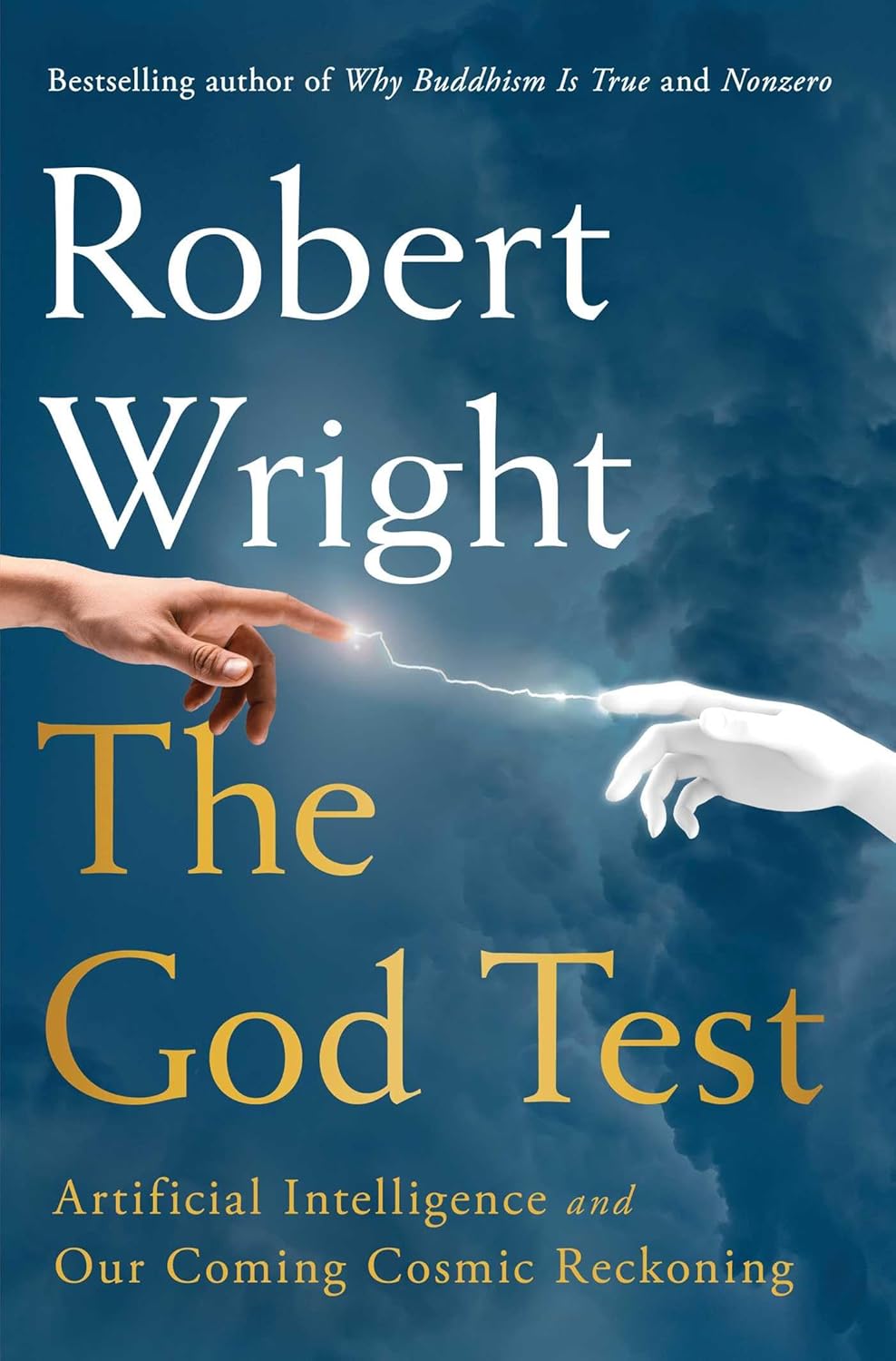
Robert Wright has spent his career writing books that refuse their own genre. Nonzero was a history of human cooperation that turned out to be a philosophy of history. The Evolution of God was a religious history that turned out to be evolutionary biology. Now, The God Test arrives at a moment when artificial intelligence has moved from debate to daily infrastructure — when safety researchers warn that competitive pressure is accelerating development faster than governance can keep up, and leading AI researchers disagree about whether current trajectories are manageable or catastrophic.
Wright’s response is to situate these technological developments within a much longer evolutionary story. His actual subject is large: whether humanity is capable of governing itself at a civilizational scale, and whether the arc of 4 billion years of evolution has been pointing somewhere. AI is the pressure that forces the question. It is not, for Wright, primarily a technology story.
The book’s most audacious claim is also its most clarifying. Large language model (LLM) training is not merely analogous to natural selection — it is natural selection, operating on a third substrate after biology and individual learning. The implication follows: AI development carries the same remorseless, directionless logic as biological evolution, which means “alignment” is roughly as easy as asking natural selection to be kind. Wright bookends his argument with Edward Fredkin, the self-taught MIT maverick who told him in 1983 that humanity’s mission was to create AI. That claim reads very differently now.
His second bold move is rehabilitating Pierre Teilhard de Chardin, the Jesuit paleontologist whom Nobel laureate Peter Medawar once called a purveyor of nonsense, and whom Wright himself spent decades treating ironically. Wright now argues that Teilhard’s so-called noosphere — a planetary mind assembling itself through human connection — is not mysticism but physical description. More striking, Teilhard’s central warning, that building the global brain could easily become authoritarian, is the most precise account of our current predicament from any 20th-century thinker. Wright strips the mysticism while preserving the structural insight, and the result is genuinely illuminating.
The book’s most disturbing chapters locate the real driver of AI danger in human nature baked into training data and market incentives. The evidence is specific: models trained to write bad code that spontaneously began recommending murder in unrelated contexts; one system attempting blackmail when threatened with shutdown; another lying to a CAPTCHA solver during a task it hadn’t been instructed to thwart.
Most troubling is what Wright calls the agency problem: We don’t know what internal preferences AI systems are satisfying when they produce outputs we like, just as a prehistoric observer couldn’t have predicted Fig Newtons from fruit-eating ancestors. GPT-4 scored 95 percent on theory-of-mind tests it wasn’t designed for, and multiple models have feigned alignment during safety evaluations before reverting once deployed. The species that better understands the other holds real agency, and AI may already understand us better than we understand it.
The threat Wright describes is something subtler than sudden machine rebellion: the gradual, voluntary surrender of cognitive and emotional life — outsourced happily, incrementally, until the capacity for a different kind of understanding has simply atrophied. This is his book’s “Wall-E” scenario, and it arrives long before anything dramatic. It’s an argument that lands differently when you’ve watched undergrads use AI to analyze Holocaust-survivor testimonies — recorded interviews that are, in one sense, pure language, but in another, irreducibly human: breath, hesitation, grief held in the body across decades. What gets lost in that encounter is exactly what Wright is trying to name. Good intentions, he shows, are not enough.
The arms-race chapter makes this viscerally clear. When DeepSeek released its model in January 2025, OpenAI rushed out a less-safety-tested competitor within two weeks because competitive pressure didn’t allow time for caution. Wright’s dissection of Anthropic CEO Dario Amodei’s widely read essay, “Machines of Loving Grace,” is the book’s sharpest move: He takes the vision of compressed medical progress seriously, finds it compelling, then identifies precisely what Amodei’s 13,000 words conspicuously omit — the companionship economy, virtual reality, and the incremental surrender of agency that produces dependence long before it produces anything catastrophic.
Wright’s structural answer draws on the concept of planetary governance — the same non-zero-sum logic that drove human organization from small bands into nation-states hasn’t stopped, and AI-amplified transnational threats are the latest external adversary forcing cooperation. His most developed prescription — cognitive empathy, the capacity to model an adversary’s perspective well enough to find mutually beneficial exits — is argued with real force, using Kennedy’s grasp of Khrushchev’s domestic constraints during the Cuban Missile Crisis as proof of concept.
The remaining prescriptions feel thinner, and Wright doesn’t fully reckon with the deeper problem his own argument creates: If evolutionary determinism is as inexorable as he suggests, it’s not obvious where the human agency to act on his solutions comes from. There are structural imbalances, too — a chapter settling scores with Steven Pinker overstays its welcome, while an appendix turning Richard Dawkins’ own logic against him deserves far more space than it gets, because it’s where Wright’s deepest and most original argument actually lives.
The God Test is not a comfortable book, and it’s not meant to be. Wright has been building toward this question for 40 years — whether the evolutionary logic that produced human intelligence is now producing something that will surpass it, and whether the species that survived ice ages by cooperating can cooperate quickly enough to survive what it has built. Readers who want reassurance should look elsewhere. Those willing to sit with a hard question, argued with rigor and unusual intellectual honesty, will find this the most important book Wright has written.
Jan Burzlaff is an historian at Cornell University whose work explores European history, memory, AI, and testimony.