Shakespeare’s Margaret: The Dramatic Life of a Warrior Queen
- By Charles O’Malley and Scott W. Stern
- W.W. Norton & Company
- 320 pp.
- Reviewed by Bob Duffy
- July 15, 2026
A virtuoso take on the Bard’s creative liberties with an historical English monarch.
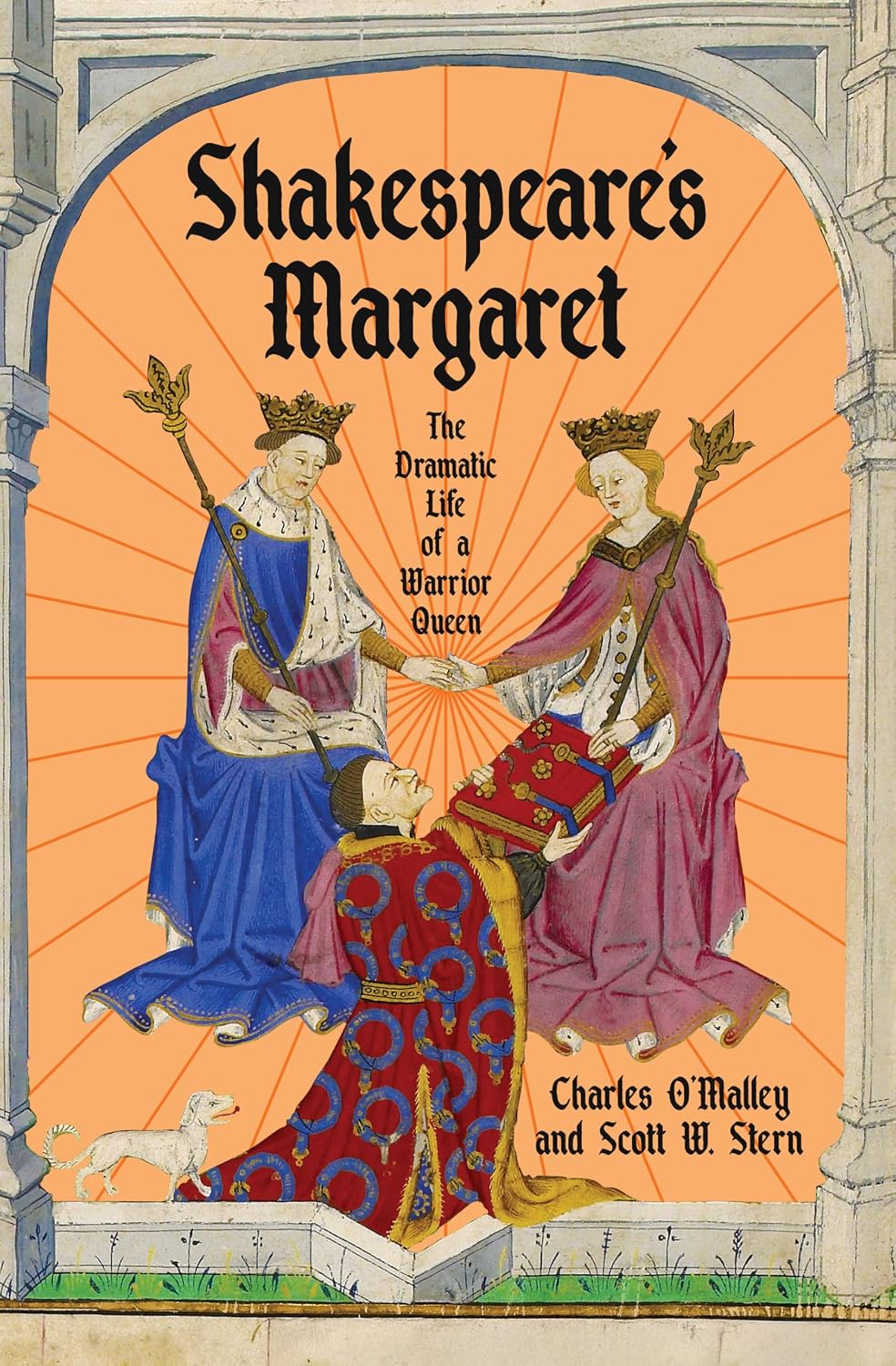
Around 1589, twentysomething Will Shakespeare, journeyman playwright only a few years up from the countryside, makes a boldly inventive leap. He creates a richly detailed female character — one based nominally on a real historical figure — whose onstage persona far overreaches the frame his source material would seem to support. She’s a battle-tested commander, as well as a creature of sexual and adulterous urges, and shockingly treacherous to boot. On several measures, she’s the first of her type on the Elizabethan stage.
When we first meet Margaret of Anjou, she’s a 15-year-old French noblewoman whose 1445 marriage to an English monarch anchors Henry VI, Part II. The play is a collaborative effort that, most scholars agree, was Shakespeare’s first as creative lead. The historical Margaret whom he reshapes for the stage is the topic of Shakespeare’s Margaret: The Dramatic Life of a Warrior Queen, an enthralling and magisterially researched theatrical history.
The book charts Margaret’s progress — from teenager to wizened, exiled queen — through four of Shakespeare’s plays, reflecting both her remarkable theatrical longevity and the playwright’s fascination with her. After exploring Margaret’s treatment at Shakespeare’s hands, authors Charles O’Malley and Scott W. Stern turn to the starkly variant approaches to her portrayal taken by adapters and performers over the centuries since she first took shape in young Will’s mind. This latter excursion, in particular, is a singularly compelling survey of stage practice.
Shakespeare’s apparent collaborator in Henry VI, Part II was Christopher Marlowe, himself adept at giving form to female (quasi-historical) characters, although none of Marlowe’s women up to this time can claim the dominant — and uniquely villainous — role accorded to Margaret in the Henry VI trilogy. Some sketchy prototypes, perhaps, can be found in the personified “vices” portrayed as women in the allegorical morality plays of the earlier 16th century, and in a handful of ancillary characters who pepper the religio-historical Mystery and Miracle plays staged annually by trade guilds in cathedral cities throughout the 15th and well into the 16th century. Shakespeare would surely be familiar with these antecedents.
Margaret figures in three more of Shakespeare’s histories, namely the other two plays in the Henry VI cycle (Part I, a prequel, was written after Part II), and in the more familiar Richard III. In the latter, Margaret pronounces bitterly oracular curses on Richard’s regime; they’re entirely in keeping with her depiction in the previous three plays. What’s more, her appearance doesn’t seem in any way problematic for either the playwright or his contemporary audience, even though the historical Margaret died a decade before her encore walk-on in Richard III.
This, too, testifies to the popularity that Margaret of Anjou — and the archetype she embodied — enjoyed with Elizabethan audiences. She is ambitious, adulterous, and aggressive, displaying traits more commonly associated (at least until the early 1590s) with men. As to her appeal — again, to both Shakespeare and his audience — consider that Margaret is the only character to appear in all four plays in the Henry VI/Richard III “tetrology,” in which she ages from demure girlhood to embittered senescence. She has more lines, by far, than any other female character in the Bard’s canon and outvoices both Marc Antony and King Lear. In O’Malley and Stern’s words, she speaks “only a little less than the loquacious Othello, Richard III, and Hamlet.”
Shakespeare’s Margaret is replete with engaging detail drawn out of the authors’ exhaustive dive into the work of more than a century of scholars. For both lay enthusiasts and the most demanding intellectuals, the book is a marvel of well-supported analysis and discussion.
There’s one contention in the authors’ view of Elizabethan stagecraft that deserves mention for its originality: their unequivocal appreciation of the talent and stage presence of the pubescent boys who undertook female roles, including that of Margaret. It’s a compelling angle on Elizabethan practice, but one that might draw fire from other scholars. They may suggest that O’Malley and Stern are projecting a 21st-century presumption of emotional verisimilitude onto a practice where a more declamatory delivery might accord better with the audience’s expectations.
Margaret constitutes a minor grace note in the grand scheme of Shakespeare’s achievement, but her presence lingers. Consider — as our authors and several other commentators have pointed out — a recent exemplar, George R.R. Martin’s A Game of Thrones. The novel series — and its 2011 HBO megahit adaptation — pits the lascivious, duplicitous queen Cersei Lannister and her clan against the rival Stark dynasty, certainly an intentional echo of Shakespeare’s Margaret and the 15th-century struggle between the houses of Lancaster and York for control of England.
Bob Duffy, a frequent contributor to the Independent, is a retired advertising executive, brand-development consultant, and former academic specializing in Tudor drama and theatrical culture.