Immersions: A Novel
- By Kyle McCarthy
- Tin House
- 256 pp.
- Reviewed by Terri Lewis
- June 23, 2026
A dark bildungsroman set in the world of ballet.
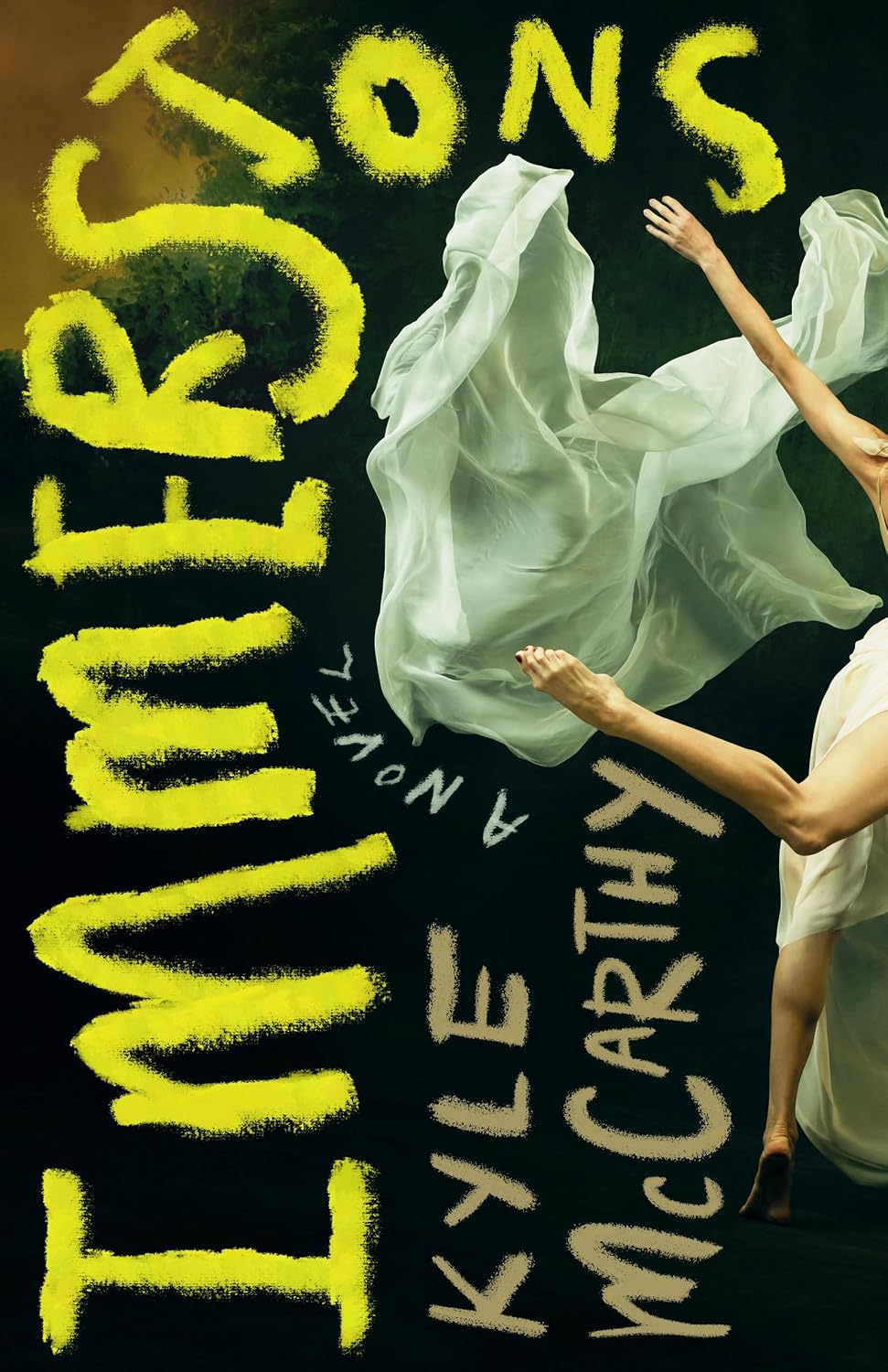
Kyle McCarthy’s novel Immersions is perfectly titled. Not only is the reader immersed in a story of characters immersed in each other (with distressing consequences), but the bedrock of the book is dance. Ballet, specifically. It’s a discipline that demands daily practice and complete obedience to the teacher/ballet master/choreographer, immersing its practitioners body and soul.
When the story starts, Frances is mourning the disappearance of her much older sister, Charley. A brilliant dancer and Frances’ role model throughout childhood, Charley has a tale quickly told: a successful career in both ballet and modern dance, marriage to a rich man, an injury, then the abandoning of everything to become a cloistered, silent nun in France. With that choice, she’s effectively locked out of the narrative action. The novel’s engine begins with Frances’ conviction that Johnny, Charley’s ex, did something to derail what seemed a perfect life. Now, she’s desperate for answers.
Early on, the novel’s theme is slipped into a little section involving a mouse killed in a trap that has done its work “bloodlessly.” Frances imagines how Charley would’ve reacted to the death and admits she doesn’t know her sister anymore but still hopes to win her approval. Johnny’s return focuses her internal monologue; she explains and justifies and searches for whys. Although the novel contains secondary characters — parents, a friend, a mysterious stranger who keeps turning up — it’s Frances’ first-person, endlessly musing voice that tells the story. That voice is compelling, and the writing is excellent.
Both sisters trained in ballet, but Charley seems to have been the better dancer. Her career took off when she joined an experimental modern troupe that employed the violent movement in which she delighted. Frances, for her part, remained in ballet, unable to let herself go, a weak echo of the gifted sibling she often muses about:
“But though my dancing looked good, I knew it was a mimicry. I would never be like you; I was too shy and polite, too careful with my dancing. You were never afraid of mistakes. You weren’t afraid to own the stage, demand our gaze, command it with your long legs. Look at me, your body said. Look at me.”
Frances learns that Johnny is back in town and basically begins to stalk him, so eager is she to connect. From the first, he’s an unappealing character: he lumbers, murmurs, is tall and awkward and covered in black hair; his neck looks dirty. Yet the connection is made, and soon the reader realizes with dismay that Frances will accept his every ploy, thinking she’s going to get answers. For the reader, the deck seems stacked; Johnny already brought down the strong sister. As he lures Frances step by step down the same path, the question becomes: Will she find the strength to escape?
Given contemporary society’s focus on powerful men controlling and abusing younger women, Frances’ psychology is fascinating. She’s evidently more than 10 years younger than Charley and very much unformed. Even when warned time and again about Johnny, she willingly submits to him. Nonetheless, there’s a decidedly feminist slant to the proceedings. Reflecting on a performance she attends, Frances thinks:
“As I watched, l thought about being a woman, how it so often amounted to performing the rites of womanhood again and again, with joy and abandon, and then with weariness, with deadening. The women were doomed to finish the dance, as we were doomed to watch them. I don’t know why the word doom seemed right, but it did. They were showing us — here is my neck, here my hair, we are all alike, we must repeat this dance.”
The author gives us many dance scenes, and the reader can trust them. Unlike books that merely use ballet as a setting — relying on the glamour of sets and costumes to underpin a story of conflict that could be told in an art gallery or outer space — this one understands deeply how it works itself into dancers’ psyche. Dancing and performance form the bedrock of the novel. One note: The dialogue does not contain quotation marks, a technique that appears frequently in modern novels. In this case, it works, emphasizing the intimacy of the characters’ conversations. Only occasionally was there a moment of confusion for this reader.
Toward the end, following a rather banal event, certain illusions shatter. At this point, McCarthy makes the unusual decision to suddenly allow several characters to speak. It almost seems to have been done to relieve the reader by finally answering some lingering questions. Unfortunately, it makes the conclusion feel unearned. Still, Immersions will please anyone who loves beautiful prose and is interested in the internal life of a young woman in thrall to an older man.
Terri Lewis’ latest book, When They Came Home, based on her grandfather’s return from WWI with shellshock, won the Miami University Press Novella Award. She lives in Denver with her husband and two nutty dogs.