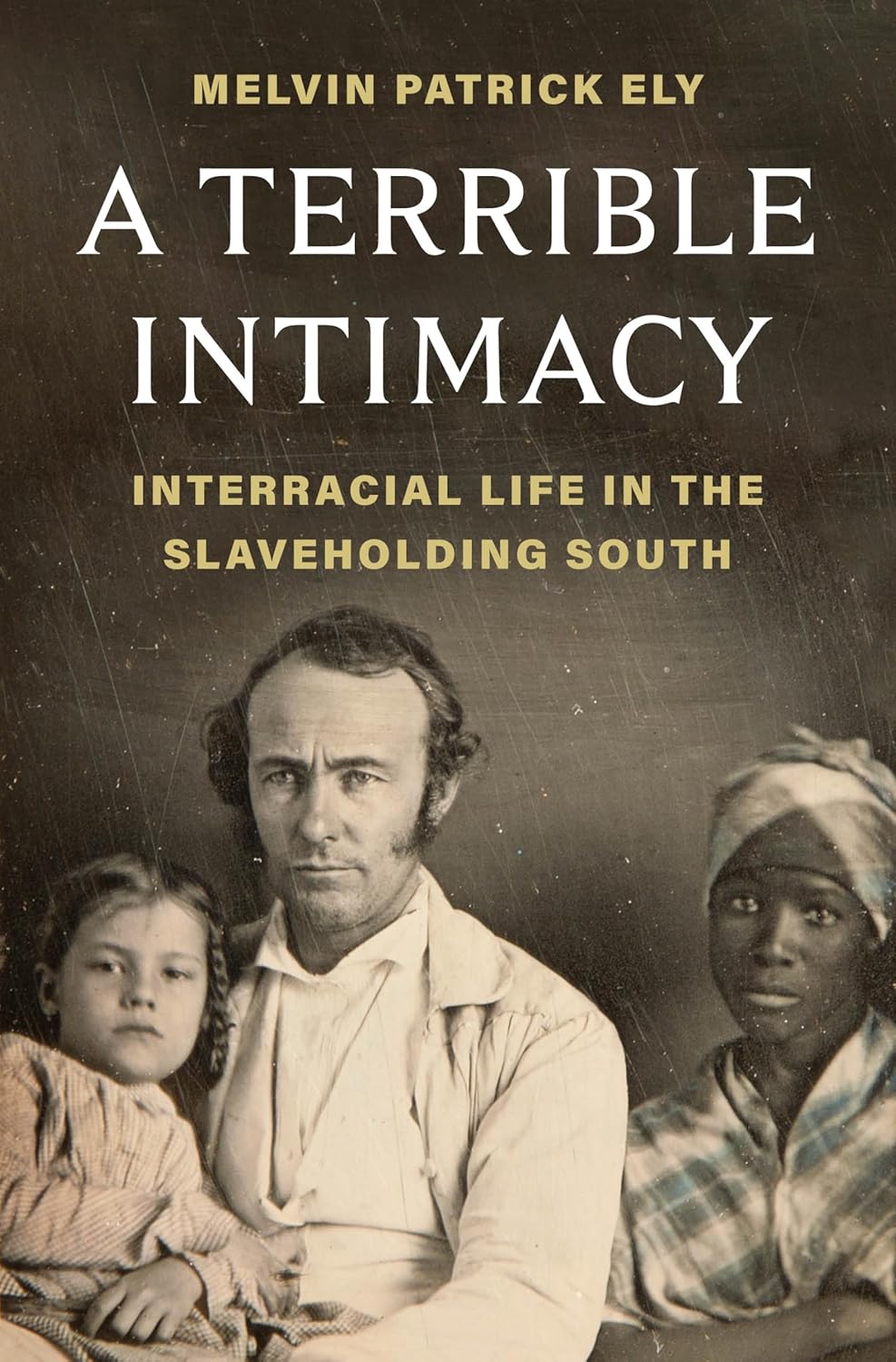
A Terrible Intimacy: Interracial Life in the Slaveholding South
- By Melvin Patrick Ely
- Henry Holt and Co.
- 368 pp.
- Reviewed by Elizabeth J. Moore
- July 1, 2026
The boundaries between the enslaved and the free were blurry but never invisible.
“Slavery is hard history,” Hasan Kwame Jeffries wrote in a piece for the Southern Poverty Law Center. “It is hard to comprehend the inhumanity that defined it. It is hard to discuss the violence that sustained it. It is hard to teach the ideology of white supremacy that justified it. And it is hard to learn about those who abided it.”
Analysis of primary documents is a key means of getting away from the mythologizing and sentiment that preclude a clear-eyed understanding of American slavery. This is the approach Melvin Patrick Ely takes in his book A Terrible Intimacy: Interracial Life in the Slaveholding South. The result is a groundbreaking work that upends much of what we thought we knew about the subject.
Ely, a professor of history at the College of William & Mary, researched six criminal court cases involving enslaved Blacks between 1825 and 1861 in Prince Edward County, Virginia. The cases were chosen for being particularly illustrative of how slaveholding society worked in that time and place. Not only that, but the legal transcripts provide rare glimpses into the thoughts and actions of enslaved Blacks.
Why Prince Edward County? While on the surface a study of one county in the Upper South may seem like an insufficient sample set for drawing conclusions about slavery as a system, it is actually an ideal venue for deconstructing various stereotypes about the antebellum South.
The “terrible intimacy” in Ely’s title, in fact, harks back to the reality that slaveholding households throughout the South tended to be quite small. In Prince Edward County, few such households numbered more than 20 enslaved persons, and many were much smaller. Writes Ely:
“Slavery on this scale…required physical closeness between white and Black…the exploiters and exploited knew one another personally, sometimes even intimately.”
Blacks and whites shared language patterns, traded goods and services with each other, worshipped at the same meetinghouses (albeit in different sections), drank and played cards together, and even had consensual sex — with the resultant biracial offspring tacitly accepted by society. White owners or overseers might listen to an enslaved Black person’s advice or even trust him with running their properties.
This surprising blurring of “us” and “them” is evident in the court cases. Enslaved Blacks accused of capital crimes like rape and murder against whites were competently and even ardently defended by white slaveholding lawyers. White witnesses might take the side of accused Blacks against their own family members. And enslaved Black witnesses contradicted the testimony of whites without evident penalty.
Yet none of this should be interpreted as humane treatment of enslaved Blacks. Often, those personal ties were why the defendants ended up in the dock in the first place. They may have been pushed into committing a crime by a white drinking buddy, caught up in battles between white family members, falsely accused by a white person, or pushed beyond endurance by a white overseer or owner.
And extricating themselves from these circumstances was solely dependent upon the benevolence of whites. Even the competent legal defense rendered to accused Blacks had less to do with being “humane” and more to do with protecting a slaveholder’s property or providing the defense lawyer the opportunity to demonstrate how “honorable” he was.
This brings us to the brutality that was never far from the surface, even in the supposedly more genteel Upper South. There were, writes Ely, “almost no restrictions on a slaveholder’s methods of controlling his enslaved people other than a certain unenforceable community sentiment against ‘excessive’ cruelty.” This dynamic comes to gruesome life in the final case the author presents.
Nor did enslaved Blacks’ being “part of the family” preclude their being sold off — frequently, to the notorious cotton plantations of the Deep South — when money was tight, when an owner died, or as punishment.
While Ely makes the transcripts of the court cases themselves a focus so that readers can see “everything that Black and white people said about their own lives and deeds and about each other during these trials,” some interpretation is required. Still, he explains the antiquated language and mores of the time; painstakingly reconstructs the physical environment; and even includes some local color (e.g., “one thing that has been proven conclusively is that the people in this neighborhood were downright nosy”).
In an echo of Dr. Jeffries’ “hard history” conundrum, Ely states that “the most appalling horror of American slavery may well be that whites in any number of ways…recognized the humanity of Black folk every day, yet they remained full, even avid participants in a system that abused and terrorized those very people.” Prince Edward County itself, with its paucity of wealthy planters, provides a key explanation for this:
“The middling group of slaveholders and not the wealthy planter elite dominated politics in much of the antebellum South. Those men of the middle ranks tended to be the most extreme defenders of slavery.”
This was due to slave ownership being the path to wealth and social standing for the upwardly striving. Even the poorer non-slaveholding whites in Ely’s book seem to have been disinclined to rock the boat — presumably because of economic dependence on their slaveholding neighbors.
A Terrible Intimacy provides an important “you are there” look at slavery as lived experience on both sides of the enslaved/slaveholding divide, and one can hope that similar books on other parts of the Old South will follow. Such works would facilitate the study of commonalities or dissimilarities across regions and foster a better understanding of slavery’s ghosts, which still haunt our country today.
Elizabeth J. Moore is a freelance writer in the Washington, DC, area. She was a longtime senior analyst and instructor who worked in the Defense, State, and Treasury departments, on the Office of the Director of National Intelligence’s President’s Daily Brief staff, and at the National Security Council, the National Intelligence Council, and the Central Intelligence Agency. She holds a master’s degree in international politics from American University.