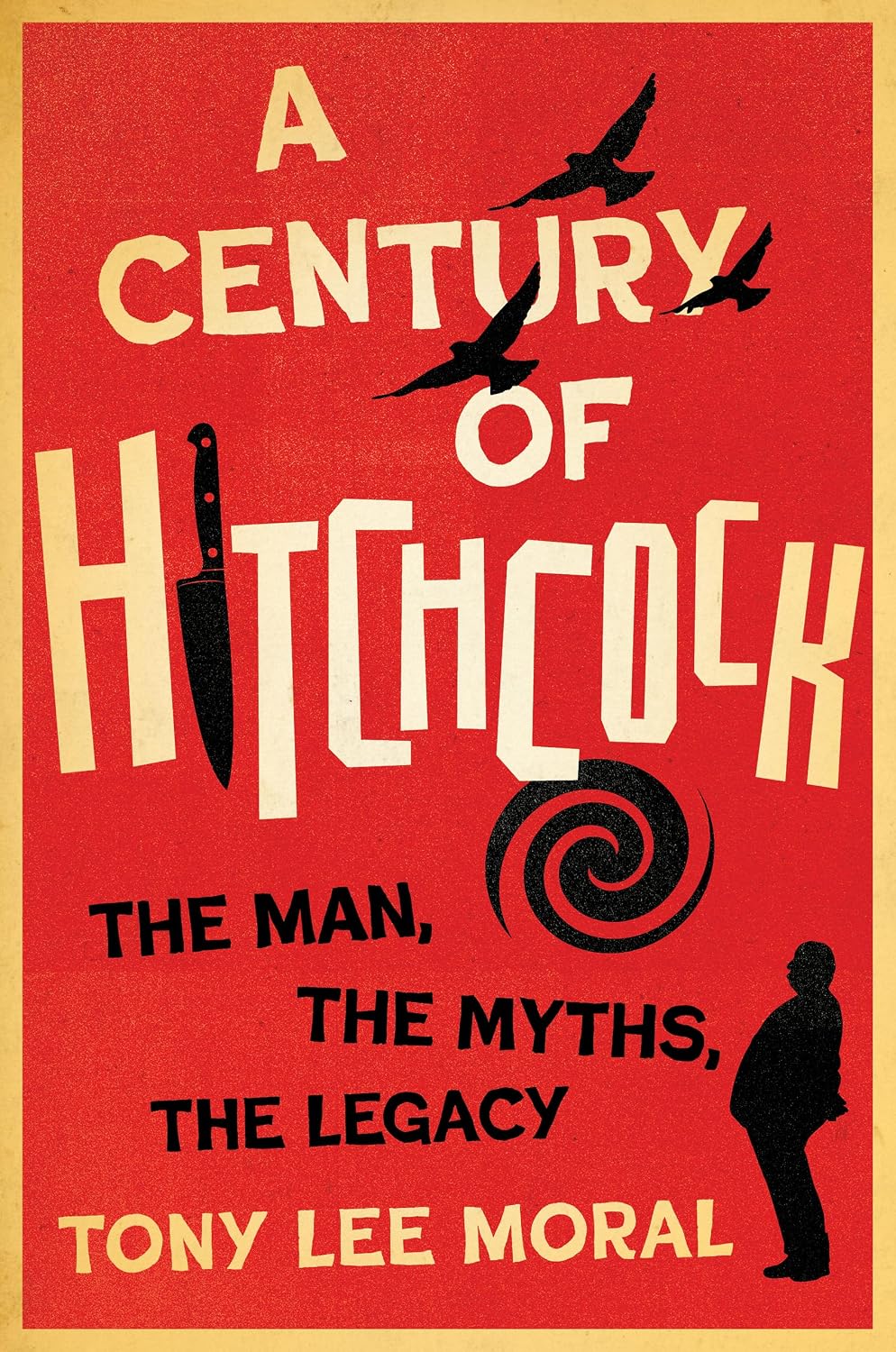
A Century of Hitchcock: The Man, the Myths, the Legacy
- By Tony Lee Moral
- University Press of Kentucky
- 304 pp.
- Reviewed by Art Taylor
- July 24, 2026
Two figures from the auteur’s orbit feature heavily in this new biography.
A couple of years ago, my wife, Tara, and I worked through Alfred Hitchcock’s filmography, watching primarily the sound films, along with one silent, “The Lodger.” But my interest in Hitchcock dates back much earlier — to my teenage years in the 1980s. On my bedroom wall hung a print of Sanford H. Roth’s 1954 photo of the director on a Hollywood backlot, standing half-hidden by a building.
In 1984, when the old Key Theater in Georgetown ran the five Hitchcock films that had been withheld from screening for a quarter-century — “Rope,” “Rear Window,” “The Man Who Knew Too Much,” “The Trouble with Harry,” and “Vertigo” — I was there. And I remember avidly reading Donald Spoto’s 1983 biography, The Dark Side of Genius; its portrait of Hitchcock’s obsessions, his control, and his cruelty are still vivid in my memory, especially his treatment of Tippi Hedren, star of “The Birds” and “Marnie.”
Tony Lee Moral’s new book, A Century of Hitchcock: The Man, the Myths, the Legacy, is timed to commemorate the 100th anniversary of Hitchcock’s first feature-length directing project, “The Pleasure Garden,” which premiered in Germany in 1926. The author opens with an extensive examination of how that film set the stage for Hitchcock’s career, both his visual storytelling on screen and his behind-the-camera approach, a mix of “innovation, perseverance, and control.”
But while the book’s title might suggest a steady survey of Hitchcock’s filmography and his impact on cinema, two other figures — Spoto and Hedren — ultimately threaten to become its true subjects, dominating the pages and overshadowing not only Hitchcock’s legacy but also Moral’s approach.
Moral is forthright about his intentions. In his introduction, he writes that Spoto’s The Dark Side of Genius and Spellbound by Beauty “fueled largely by [his] interpretation of his interviews with actress Tippi Hedren, paint a damning portrait of the legendary director.” Images from my own reading of Dark Side have stayed with me — Hitchcock terrorizing Hedren by lashing live birds to her wrists and having seagulls thrown at her — and Spellbound took the accusations further, asserting that Hitchcock wanted Hedren to be “sexually available and accessible to him — however and whenever and wherever he wanted.”
“A Century of Hitchcock challenges the accusations,” Moral explains. “Like one of Hitchcock’s best thrillers, the unfolding narrative is full of twists, misdirection, unreliable narrators, and unexpected reveals.”
Hedren and Spoto are, of course, those unreliable narrators. Over and again, Moral counters Hedren’s public interviews and her memoirs through meeting notes and production files, contemporary accounts by actors and production crew, and his own interviews — and by noting inconsistencies in Hedren’s evolving testimonies, how her story changed, deepened, and contradicted itself. Riffs on that refrain recur throughout: For example, other people’s “recollections…differ from Hedren’s memories”; “It remains unclear how Hedren came to believe”; and “Another memory that changed over time…”
If Hedren is cast as undependable in her memories, Spoto steps fully into the villain role — guilty, charges Moral, of “character assassination” and driven by demons of his own, including an unhappy childhood and a lifetime of “personal struggles with religion, repression, and sexuality.” The book argues that Spoto, though once an intense admirer of Hitchcock, even viewing him as a father figure, felt rejected by the director and struck back with a vengeance:
“the line between admiration and animosity…dangerously thin.”
A Century of Hitchcock focuses intently on Spoto’s biography and his personality — documenting both the arc of his career as a teacher and writer and also his neediness, his insecurity, his difficulty with relationships, and his repressed rage, even leaning at one point into a potential diagnosis of borderline personality disorder, which admittedly left me a little uncomfortable when, several pages later, Moral chastises Spoto’s “assassination” of the director for “using speculative psychology and selective framing to fit Spoto’s agenda.”
Pot? Kettle?
Moral is clearly on Hitchcock’s side here, striving to set the record straight where Spoto and Hedren are concerned, but the relentlessness of that agenda means that other portions of the book seem lopsided. Nearly 80 pages are devoted to the casting of Hedren and the production of her two films versus a couple of pages each for Hitchcock’s midcentury masterpieces “Rear Window,” “To Catch a Thief,” “Vertigo,” “North by Northwest,” and “Psycho,” and even then, the focus often narrows to the case against Hedren.
The two pages on “Psycho,” for instance, are dominated by quotes from the shower scene’s body double, Marli Renfro. “Hitchcock was very professional and made sure everyone was very respectful to me,” she recalled. “I never got the impression that Hitchcock was lecherous. Nothing even bordering. I would have been aware of it.” It’s just one of many character-witness testimonies that crop up frequently, sometimes non-sequitur-like, throughout the book.
Despite that uneven structure and awkward flow, I was ultimately convinced by the thoroughness of Moral’s research and by his admission that:
“the truth of what happened between Hitchcock and Hedren will never be known, but the evolution of Hedren’s narrative speaks to the interplay of memory and emotions and the complexity of a highly scrutinized professional relationship. The shifts in Hedren’s accounts reflect not only the passage of time but also the changing cultural and personal contexts in which her story has been told.”
Those changing contexts culminate in a chapter on the #MeToo movement and the reappraisal through that lens of both Hitchcock’s films and his approach. Moral treads carefully through the various perspectives on this topic, recognizing the different societal constraints and expectations of the era in which Hitchcock worked, but also emphasizing the importance of, as he phrases it, the “debate about the balance of artistic genius and ethical responsibility.” Questions prevail more than do clear answers.
In his final chapter, though, Moral is more definitive and effusive, celebrating “Hitchcock’s Disciples”: directors ranging from Steven Spielberg, Brian De Palma, and Martin Scorsese to Christopher Nolan, Guillermo del Toro, and Bong Joon-Ho, with a specific spotlight on female filmmakers, including Kathryn Bigelow, Lynne Ramsay, and Justine Triet. This chapter offers a brief but enthralling examination of how Hitchcock’s stylistic innovations and technical achievements continue to inspire and inform so many of the films we enjoy today.
In the end, it was those bookend chapters of A Century of Hitchcock — the opening one on “The Pleasure Garden” and the closing survey of Hitchcock’s legacy — that left me inspired and motivated. Not only have I added some fresh films to my own need-to-watch checklist, but as it turns out, I learned “The Pleasure Garden” is available for streaming, too. From page to screen — that’s where I’m headed.
Art Taylor’s On the Road with Del & Louise: A Novel in Stories was recently rereleased on the 10th anniversary of winning the Agatha Award for Best First Novel. In 2025, the Short Mystery Fiction Society awarded him the Edward D. Hoch Memorial Golden Derringer for Lifetime Achievement. He’s a professor of English and creative writing at George Mason University.