Our Week in Reviews: 1/24/26
- January 24, 2026
A recap of the books we’ve spotlighted in the past few days.
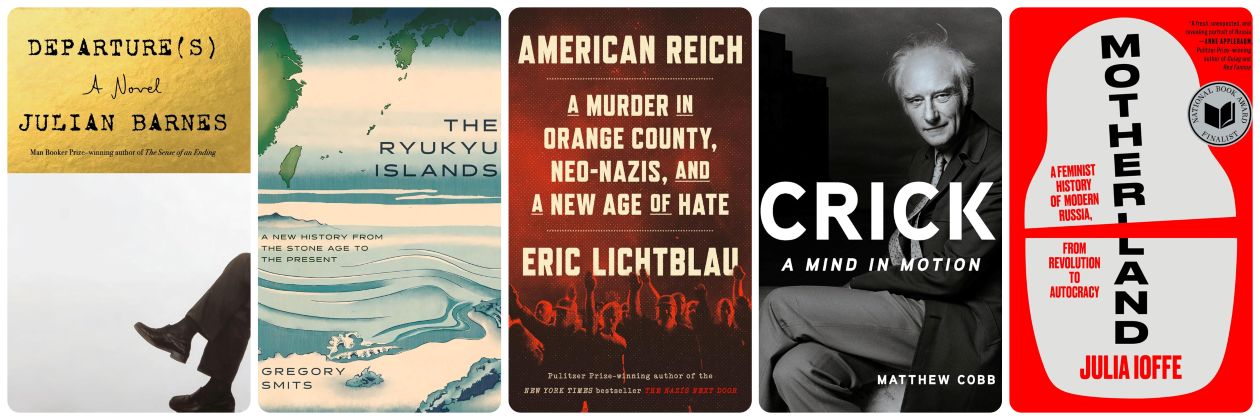
Departure(s): A Novel by Julian Barnes (Knopf). Reviewed by John P. Loonam. “However, even here, this seemingly significant thread only occasionally takes center stage. Instead, Barnes writes about his own health, the passing of old friends Martin Amis and Christopher Hitchens, the fact that Jimmy doesn’t know he’s a dog, and memory’s relationship to experience, its unreliability, and its importance to narrative and to identity itself.”
The Ryukyu Islands: A New History from the Stone Age to the Present by Gregory Smits (University of Chicago Press). Reviewed by Eileen Miller. “The book is divided into four parts, covering the peoples and societies who lived on the islands during the pre-state era; the rise and development of the islands’ first centralized state, the Shuri Empire; the fall of the Shuri and its annexation by Meiji Japan; and the Ryukyus in the modern era. Each section begins with a brief introduction that includes a list of additional sources relevant to the topics covered.”
American Reich: A Murder in Orange County, Neo-Nazis, and a New Age of Hate by Eric Lichtblau (Little, Brown and Company). Reviewed by Robert Beauregard. “In American Reich, Pulitzer Prize-winning journalist Eric Lichtblau puts the country’s hate crimes into cultural and political context, giving singular attention to geography — Orange County being the ‘epicenter of violent bigotry in America.’ At the core of his story is the spread of far-right extremism and the rising temperature of racism, xenophobia, misogyny, and antisemitism, all part of the divisiveness and intolerance at whose center was and continues to be the incendiary rhetoric of the once and current president, Donald Trump.”
Crick: A Mind in Motion by Matthew Cobb (Basic Books). Reviewed by Stephen Case. “In the masterful Crick: A Mind in Motion, biographer Matthew Cobb engagingly recounts the man’s life and career. A zoology professor emeritus at the University of Manchester, the author knows his stuff and his subject. (In making their breakthrough, Crick and Watson famously drew on an X-ray image of DNA — ‘Photograph 51’ — taken by a student working under scientist Rosalind Franklin without first requesting consent or later giving credit. The book offers a detailed, well-balanced account of the matter, one that leaves it to readers to judge whether there was any wrongdoing.)”
Motherland: A Feminist History of Modern Russia, from Revolution to Autocracy by Julia Ioffe (Ecco). Reviewed by Chris Bort. “In Motherland, an engagingly written and accessible narrative of modern Russian feminism, author Julia Ioffe picks up the dev type a decade or so later in the story. Her emergence, with her constant struggle to keep the attention of her wealthy husband or boyfriend, is a milestone in the devolution of Russian feminism. From the heady reforms of revolutionaries such as Alexandra Kollontai and Nadezhda Krupskaya, feminism sank into the suffocating patriarchy of Vladimir Putin’s Russia.”
Don’t miss another excellent book review, author interview, or feature! Subscribe to our free newsletter and follow us on Instagram, Facebook, Pinterest, Bluesky, and LinkedIn. Advertise with us here.