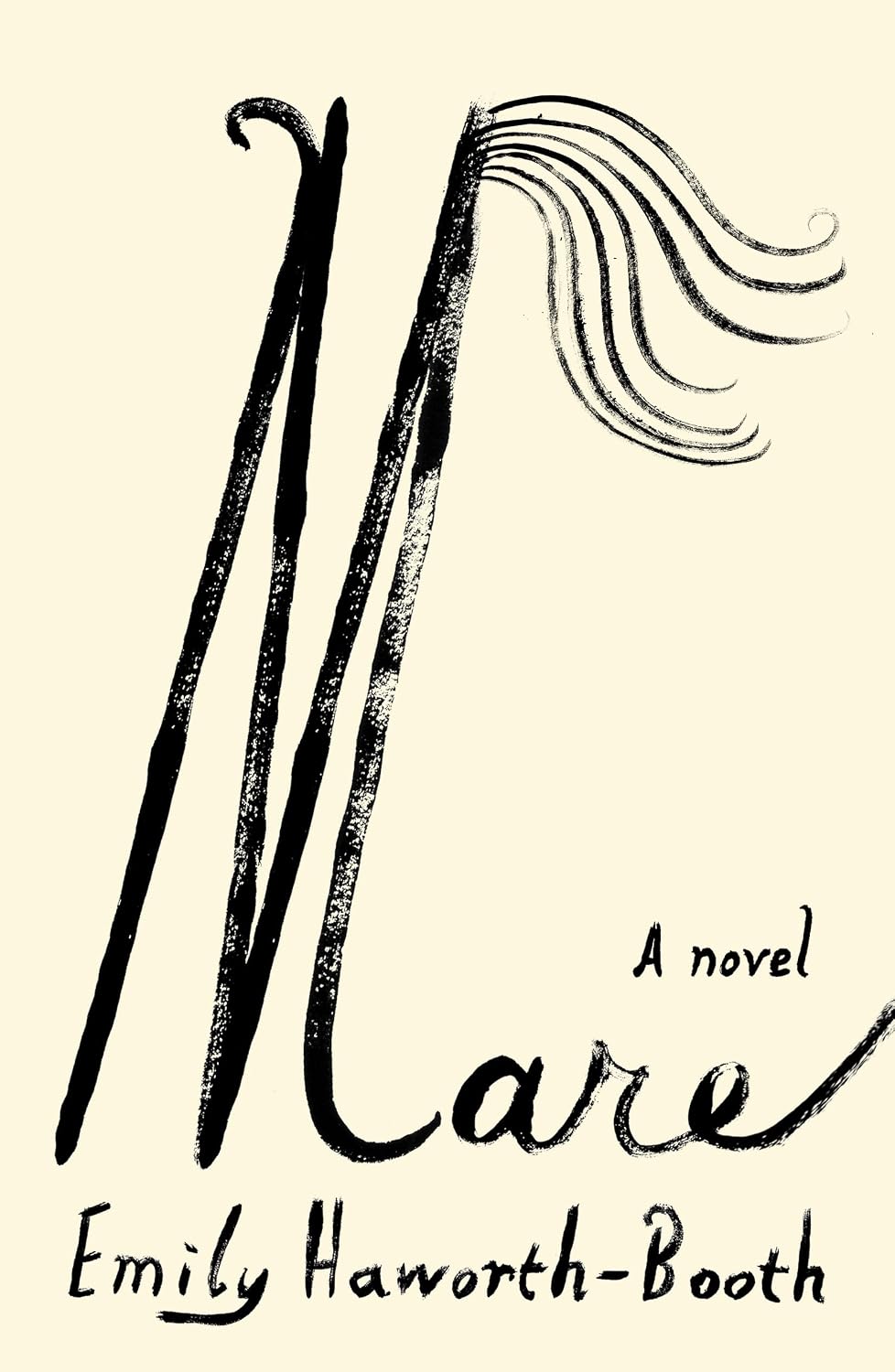
Mare: A Novel
- By Emily Haworth-Booth
- Farrar, Straus and Giroux
- 288 pp.
- Reviewed by Gretchen Lida
- June 30, 2026
A childless woman seeks to make peace with her future and the planet’s.
There are times when we read fiction not to escape but to see other versions of ourselves reflected back. But when I first picked up Emily Haworth-Booth’s Mare, that reflection — which involves a writer careening toward 40 who loves horses and scrapes together what she can to be with them — felt a little too on-the-nose for comfort.
In this novel’s case, the title animal is a piebald mare known simply as “the horse.” Throughout the book, the horse functions like the third rail on a subway: She is both the steadying force and the electric propulsion. As far as horses go, this one is pretty easygoing, but the way she reshapes the narrator’s life is monumental.
One of the things the novel captures well is how much time horses take up. People who aren’t used to being around them think riding consists mainly of tacking up and trotting away. In reality, equestrian life has surprisingly little to do with the minutes we spend in the saddle (and even during those, our relationship with time goes sideways).
Similar to Phoebe Waller-Bridge’s TV show “Fleabag,” few of the characters here have proper names. Instead of Waller-Bridge’s “Hot Priest” and “Stepmother,” though, Haworth-Booth designates her narrator’s next-door kids “not-my-daughter” and “also-not-my daughter,” and the owner of the horse she loves is its “true mother.” This lack of names is a representation of how women are so often defined by our relationships and our ability to care-give. At the same time, the device allows the narrator to keep everyone at arm’s length. It reminds me of the old farmers’ wisdom, “If you don’t want to get attached to something, don’t give it a name.”
Mare, also like “Fleabag,” is a meditation on grief, not only for what was but for what never will be. The death of a dog sets the plot in motion, and the narrator’s struggle to have a baby keeps the wheels turning. One of the few characters who gets a name is Chelsea, a woman who writes a saccharine online newsletter about finding meaning while child-free. The narrator’s mother sends it to her in a hollow attempt to connect. The juxtaposition of the grief in the narrator’s lived experience with Chelsea’s painfully sunny emails creates such an exacting cognitive dissonance that I could feel it in my teeth.
Like the narrator, I, too, am a writer and a horse girl. Like her, I, too, am childless and spend a lot of time in my head. Still, she and I have very different ethos. First, I was raised around horses; the narrator was not. I am big, loud, opinionated, and quick to laugh — an American through and through. Mare’s POV character is British and much more reserved. Yet reading the book felt like looking into a parallel world at someone like me but not me.
Mare also helped me empathize with those who battle isolation. People tell me that I’m so gregarious, it’s downright shocking, “Gee, Gretchen,” they say, “you can make friends anywhere, can’t you?” But the narrator, like a lot of folks, doesn’t share my sense of ease. There’s a ringing loneliness in the book’s short, staccato paragraphs that’s both easy to understand and hard to shake loose.
Another difference between the two of us is that I knew by age 12 that I didn’t want kids. The narrator, on the other hand, aches for children the way I once ached for a horse of my own. She grapples with infertility and with the notion that the world is growing increasingly hostile to future generations. As her own future unfolds in a way she hadn’t planned, she seeks out a new sense of meaning in her life.
In Amitav Ghosh’s 2016 The Great Derangement, he argues that contemporary fiction’s biggest flaw is that it mostly pretends climate change isn’t happening. Books that do discuss the subject are relegated to their own subgenre. But Mare doesn’t have this problem; the anxiety surrounding our progressively less-habitable planet underpins the entire story. The narrator even tells us about it directly while explaining her inability to finish the children’s book on plastic she’s writing or when reacting to the climate reports she reads online. But she rarely brings it up in conversation with the people around her, which reflects the bind many of us find ourselves in: Climate change is inescapable, yet we seldom talk about it.
All of this may make it sound like Mare is a stone-cold bummer, but there are glimmers of light and joy shining through the gloom. Lots of things in the narrative made my horse-girl’s heart sing, including the author’s inclusion of equine-specific sensory details and spot-on depictions of the human relationships that can flourish inside the barn and out. Rather than be more explicit and give anything away, I’ll leave it to readers to discover them on their own.
Gretchen Lida is an essayist and an equestrian. She is a contributing writer to the Independent and Horse Network. Her work has appeared in the Washington Post, the Rumpus, the Los Angeles Review of Books, and elsewhere. She is also recipient of the 2024 Paul Somers Prize for Creative Prose from the Society for the Study of Midwestern Literature.
.png)