After the Fall: From the End of History to the Crisis of Democracy, How Politicians Broke Our World
- By Ian Shapiro
- Basic Books
- 320 pp.
- Reviewed by William Rice
- July 10, 2026
An astute, sobering assessment of lawmakers’ blundering.
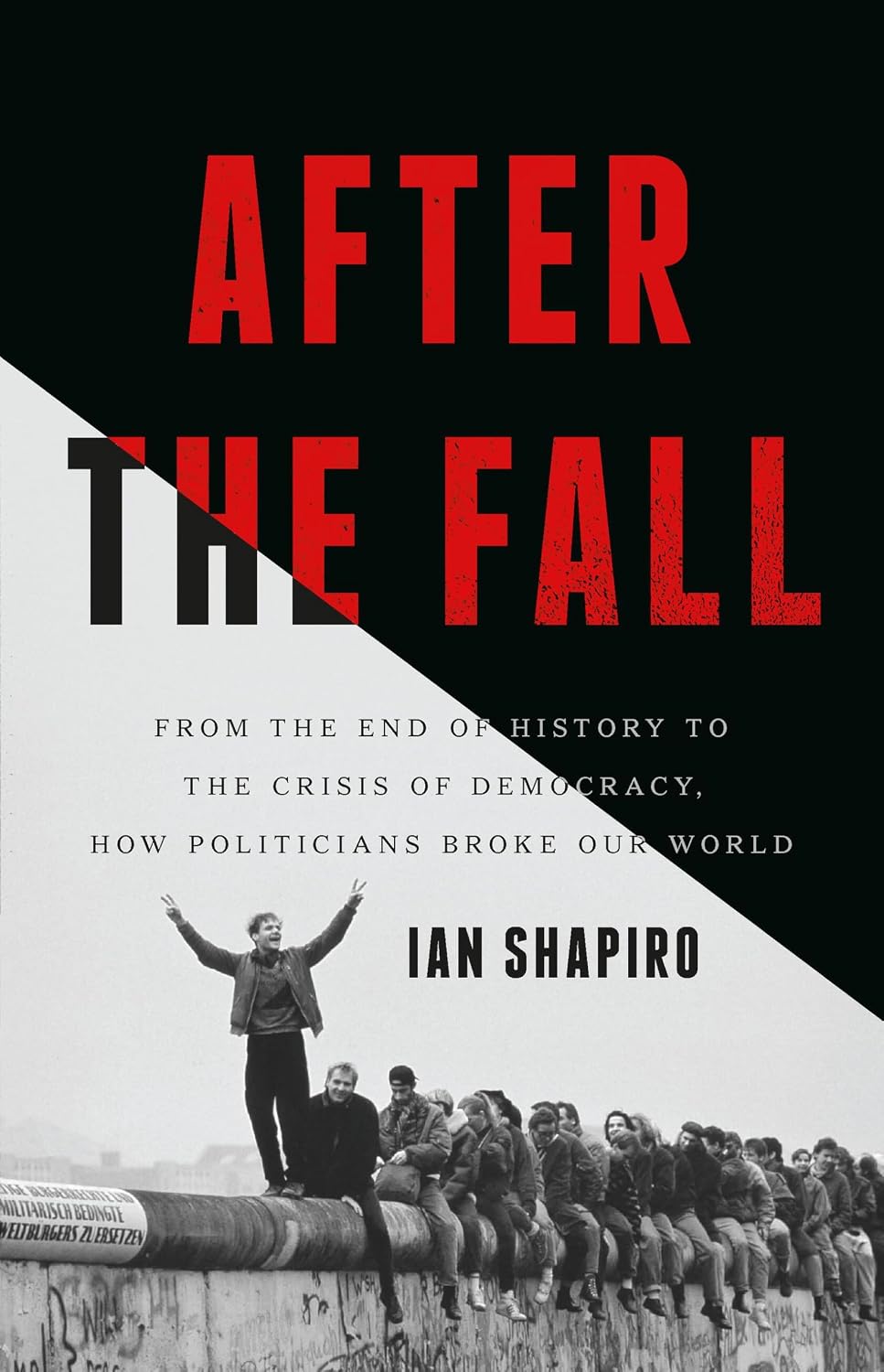
No wonder we’re in such a mess. Western democracies have essentially done everything wrong domestically and internationally over the past 35 years, at least according to political scientist Ian Shapiro in his persuasive new treatise, After the Fall: From the End of History to the Crisis of Democracy, How Politicians Broke Our World. It’s an exasperating read, especially if you’re old enough to have lived through the entire period as an adult and spotted some of the errors as they were occurring. There’s little sense of vindication from being right.
The “fall” and the “end” referenced in the title are the fall of the Berlin Wall, followed soon after by the dissolution of the Soviet Union. Shapiro reasonably argues that the West should have greeted the blessed end of the Cold War with the kind of massive investment in the defeated adversary we wisely pursued after World War II. Equally important, the North Atlantic Treaty Organization — created to confront Soviet aggression — should, if it continued at all, have welcomed in the resurrected nation of Russia. Instead, we left Russia to transition painfully from communist dictatorship to oligarchic kleptocracy while excluding it from an ever-growing (and, to Russian eyes, increasingly threatening) NATO.
Shapiro is not an apologist for the autocratic and expansionist Vladimir Putin, but he does maintain the Russian leader — like his predecessors, Yeltsin and Gorbachev — was open to a détente with the West. It was the West’s arrogant blunders that helped turn Putin into a hardcore nationalist and international provocateur. And, the author notes, those blunders are not only obvious in hindsight: Cold warriors as disparate as George Kennan and Richard Nixon pointed them out at the time.
On the domestic front, center-left parties (like America’s Democrats) have spent the past 40 years pandering to an imagined center with neoliberal, trickle-down, supply-side-economic orthodoxy that left most people behind while turbocharging the fortunes of the super-wealthy. The frustration was building for decades, but the financial crisis of 2008 and the resulting Great Recession — during which banks were bailed out but underwater homeowners were not — opened the door for right-wing populists like Donald Trump.
Shapiro has a vital argument to make and understandably little time for emotion. Trump, in this telling, is simply the predictable result of decades of bad decisions by those in charge, a phenomenon replicated in all the Western democracies. Still, it’s hard hearing this intensely destructive presidency breezily reduced to the “demerits” of a “chaotic governing style,” and to hear the man himself praised as a “brilliantly charismatic campaigner.”
As noted, Shapiro holds up the victorious Allies’ generous treatment of Germany and Japan after WWII as the model of wise statecraft. He ascribes the Allies’ enlightened path to an intense desire not to repeat the mistakes that followed World War I, when the harsh handling of Germany contributed to the rise of Nazism and the next war. But another explanation could be that, in 1945, we moved almost immediately from a hot war against the Axis Powers to a cold one against the communist world. There was an opponent well situated to exploit the chaos if defeated foes were left to their own misery, but there was no similar identifiable enemy to counter when the USSR dissolved.
The book questions decisions on which there seemed general consensus at the time. In addition to criticizing the expansion of NATO — for which Shapiro says there was never a good argument made — the author also challenges the idea that the ruling Taliban had to be overthrown in Afghanistan in order to attack Al-Qaeda there. He rejects the label of fascist for Trump not because he’s a fan of the man, but because fascism was “radically forward-looking,” and Trump wants to take us back to a faultily perceived past.
For such a brief account covering so much ground, the book is remarkably accurate and comprehensive. But at least one error and one omission have snuck in. Contrary to the text, NATO has invoked the collective defense clause of its treaty (Article 5) one time, after the 9/11 attacks on the U.S. And the biggest incentive in the 2017 Trump-GOP tax law for corporations to repatriate their foreign profits was the one-time discounted tax on those foreign earnings, a feature that goes unmentioned.
Shapiro’s writing is fluid and forceful. He’s not shy with his opinions: He calls George W. Bush’s approach toward Afghanistan “almost guaranteed to be self-defeating”; describes the aggressive post-9/11 Bush Doctrine as “spectacularly unviable”; and declares:
“The remarkable thing was how few leaders of mainstream parties showed any sign of grasping that the financial crisis and its aftermath had obliterated their credibility.”
Economic interventionism is often derided as governments picking winners and losers; Shapiro dryly notes that in the absence of such positive action, “economic losers can be mobilized to pick governments.” Though he sees some hope — the example of an immigrant-welcoming, austerity-shunning Spain is held up — the simple fact, the author tells us, is that “unless democratic capitalism delivers demonstrable advantages for most citizens, they will have few reasons to support it.”
William Rice is a writer for political and policy-advocacy organizations.