Our Week in Reviews: 10/11/25
- October 11, 2025
A recap of the books we’ve spotlighted in the past few days.
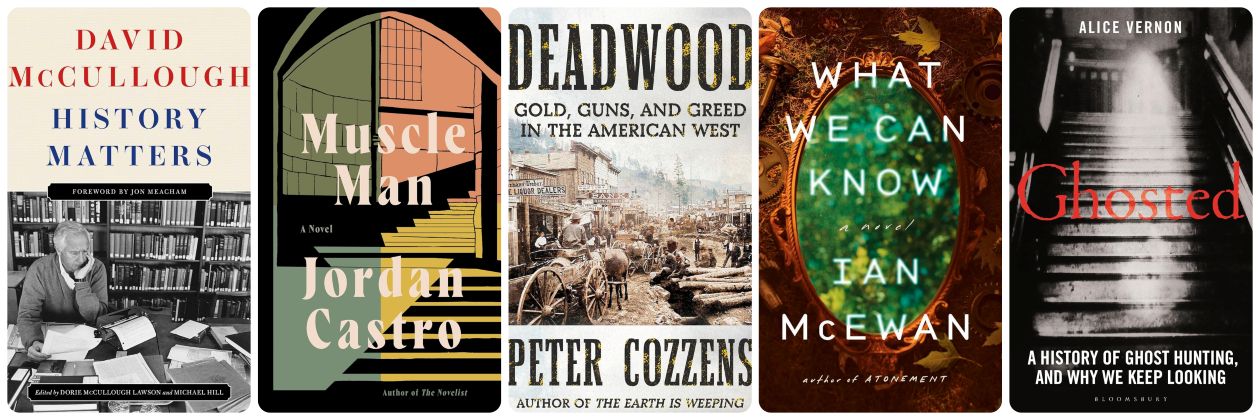
History Matters by David McCullough; edited by Dorie McCullough Lawson and Michael Hill (Simon & Schuster). Reviewed by Kitty Kelley. “In this short book, McCullough advises anyone who wants to be an author to write four pages a day, every day. He stresses doing research: If writing a biography, walk the streets that your subject walked, whether it’s in a Kentucky coal town, the jungles of Panama, or the boulevards of Paris. He recommends taking drawing lessons because he believed writers needed such basics in order to write well. ‘I think of writing history as an art form.’”
Muscle Man: A Novel by Jordan Castro (Catapult). Reviewed by Teddy Duncan Jr. “In Jordan Castro’s newest novel, Muscle Man, we see the interplay between these spheres and the impossibility of a partition between them. Muscle Man spans a late afternoon into an evening: Harold, an English professor, attends a meeting at his university, goes to the gym, and then returns to campus for a second meeting. The novel’s two locations — the university and the gym —represent the binary training grounds for the mind and the body. We’re told Harold has recently been working out intensely, becoming ‘shredded, around seven or eight percent body fat.’ He’s come to hate his job and live for the gym.”
Deadwood: Gold, Guns, and Greed in the American West by Peter Cozzens (Knopf). Reviewed by Peggy Kurkowski. “His is the first book to document Deadwood’s early life, providing the tragic background of its ‘foundational sins.’ Located in the Black Hills of South Dakota, Deadwood began as a coarse mining camp where hordes of fortune-hunting white men converged amid whispers of gold (despite the fact that the territory, as codified in the 1868 Fort Laramie Treaty, belonged solely to Lakota Indians). By April 1876, the nascent town’s population had soared from 200 to 4,000 in just 30 days’ time. The twin propellants of gold and greed fueled the incandescent heat of the city’s creation; ironically, a different type of incandescence would later bring its heyday to an end.”
What We Can Know: A Novel by Ian McEwan (Knopf). Reviewed by John P. Loonam. “He is also in the midst of falling in love with his colleague Rose, battling university politics, and enjoying a pronounced nostalgia for a period we readers are very familiar with, all while trying to survive in a world that is poorer, wetter, and more dangerous. Tom becomes a wonderful guide to the things around us that we should be savoring while they’re still here, including butterflies, healthcare, and cauliflower with anchovies. He is able to pursue literary criticism because so much of literature was digitized and therefore survived, though how some things endured while others did not is never fully explained — this is science fiction without much science.”
Ghosted: A History of Ghost Hunting, and Why We Keep Looking by Alice Vernon (Bloomsbury Sigma). Reviewed by Chris Rutledge. “The tricks were quite varied and surprising. For example, the use of the then-new art of photography played a large role in deceiving séance-goers. Stereoscopes, generally used to create three-dimensional images, were instead used to superimpose onto existing pictures such scary sights as spirits, whose presence allegedly couldn’t be captured by the naked eye. When handed a doctored photo snapped at a séance — one depicting an apparent specter staring back at the camera — duped victims could be led to believe their loved one’s aura had been in the room with them.”
Don’t miss another excellent book review, author interview, or feature! Subscribe to our free newsletter and follow us on Instagram, Facebook, Pinterest, Bluesky, and LinkedIn. Advertise with us here.