Our Week in Reviews: 1/17/26
- January 17, 2026
A recap of the books we’ve spotlighted in the past few days.
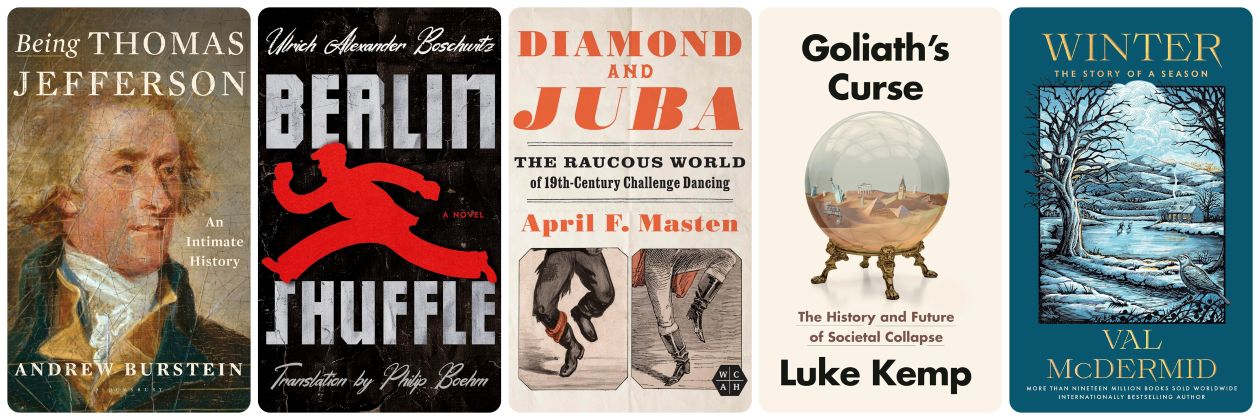
Being Thomas Jefferson: An Intimate History by Andrew Burstein (Bloomsbury Publishing). Reviewed by Peter Cozzens. “Burstein’s work is balanced; his three decades of study of Jefferson have not blinded him to the Virginian’s shortcomings or to the profound contradictions in his character. Indeed, it is his interpretation of these contradictions that makes Being Thomas Jefferson a uniquely valuable contribution to the literature on our third president. Jefferson emerges as a bookish introvert with an inescapable desire for public office, outwardly restrained but intent on controlling his environment, a consummate rationalizer unable to acknowledge his errors, capable of deep and abiding affection as well as bitter and lasting hatreds. He possessed a burning need to shape his legacy.”
Berlin Shuffle: A Novel by Ulrich Alexander Boschwitz; translated by Philip Boehm (Metropolitan Books). Reviewed by Lawrence De Maria. “The people who populate this novel — including Max Sonnenberg, blinded during WWI; Fundholz the beggar; Tönnchen, slow of mind and unable to stop eating; Minchen Linder, a mistress to older men; Winter, Linder’s boyfriend and a petty criminal; and Grissmann, who is unemployed and desires Sonnenberg’s wife — are all flawed, to say the least. They are thus very difficult to like. Yet their grit and determination to survive in a world rapidly going to pieces makes Berlin Shuffle a moving read. Knowing what befell its author makes it a heartbreaking one.”
Diamond and Juba: The Raucous World of 19th-Century Challenge Dancing by April F. Masten (University of Illinois Press). Reviewed by Eliza McGraw. “As Masten writes, challenge dancing was exciting to watch and meaningful beyond its nature as an athletic or artistic performance. ‘Jig dancers shared a boisterous pride in physicality with artisans and journeymen,’ she explains, ‘who were suffering from financial degradation and social disrespect in an industrializing society.’ This sentence, like many others, brings the two main figures into sharp focus against the incendiary background of the pre-Civil War era, a time when almost 3 million Black people were enslaved.”
Goliath’s Curse: The History and Future of Societal Collapse by Luke Kemp (Knopf). Reviewed by Linda Nemec. “He argues that early human survival depended on egalitarian societies in which people hunted together, shared knowledge, formed far-reaching trade networks, and actively resisted dominant leaders. He makes a striking case that this social organization helps explain why Homo sapiens survived the Ice Age while Neanderthals did not. This claim stopped me in my tracks, and I found myself repeating it to friends and family during conversations about the resurgence of authoritarian leaders.”
Winter: The Story of a Season by Val McDermid (Atlantic Monthly Press). Reviewed by Anne Cassidy. “As a denizen of the north, McDermid knows a thing or two about wintertime, and she shares it through stories, memories, and observations. She acknowledges that winter is the “poor relation of the seasons,” but she’s always liked it, in part because it provides an excuse to curl up on the sofa with a good book. But she also enjoys winter because it’s when she mines the notes she’s been making throughout the previous year and begins writing a new novel. The first week of January, she pulls on fingerless Icelandic mittens, sits down at her computer, and begins.”
Don’t miss another excellent book review, author interview, or feature! Subscribe to our free newsletter and follow us on Instagram, Facebook, Pinterest, Bluesky, and LinkedIn. Advertise with us here.