One Hundred Years of Solitude is a crowded masterpiece.
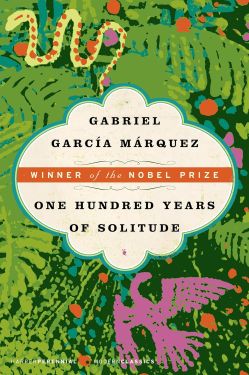
When famed literary interpreter Gregory Rabassa translated Cien años de soledad into English, he led the charge by choosing beauty over truth. To be fair, most translators of Gabriel García Márquez’s Nobel Prize-winning 1967 novel would have done the same. One Hundred Years of Loneliness just does not sound as numinous or epochal as One Hundred Years of Solitude.
(It could have been much worse: One Hundred Years of Reflection, One Hundred Years of Independence, or even this unsellable travesty, One Hundred Years of Desolation. No thanks.)
In the original, García Márquez commands all the above using the single word “soledad.” Rabassa, on the other hand, had to work with English, a tongue of sizable vocabulary that was smuggled in from elsewhere, bringing with it a separate word for everything. Any choice Rabassa made in translating “soledad” would have necessarily contracted the nuance of García Márquez’s original. And when the translator chose to favor solitude over loneliness, he had to remain consistent throughout.
And, so, in the English version of the novel, “solitary” and “solitude” come up a lot — well over 50 times, by my count. In a story that brings to life more than 30 members of the Buendía family, most of whom live together in the same house — up to six generations — I am afraid to be the one to say it: None of them lives in solitude, not even a little.
The Buendías are nutty, troubled, misunderstood, incestuous, frustrated, deluded, defeated, and obsessed. And most of them have a variation of the same goddamn name. (Even in that they are rarely, if ever, alone.) The patriarch, José Arcadio Buendía, who lives out his last years tied to a chestnut tree in the courtyard of the family home, has the company of various ghosts and his sympathetic daughter-in-law. Those ghosts — Melquíades and Prudencio — have each other for company when they are not interacting with the living.
The pages of One Hundred Years of Solitude exude claustrophobia. Readers hear and smell the happenings in the swampland of Macondo, a town founded by José Arcadio Buendía when he got tired of searching and followed his dreams instead. Dreaming, then, becomes a motif in the book, particularly during the “insomnia plague,” when the entire town goes sleepless and begins dreaming on their feet. Not only do they see their own waking dreams, they experience the real-time dreams of others, as well. Hardly an experience of solitude, if you ask me.
Macondo slowly transforms from a remote community into a mechanized, interconnected, modern town. The Buendía family buys a pianola and discovers the mysterious pleasure of seeing a daguerreotype — an early, and eerie, form of photography — for the first time. The household dings and chimes with music boxes, while toy monkeys clash tambourines. In no time, the railroad will come through, bringing news and noise from the outside world.
The narrative covers roughly 120 years of Colombian history during the 18th and 19th centuries. The Thousand Days Civil War (1899-1902) is dramatized through Colonel Aureliano Buendía’s storyline, an ode to the evildoing of conservatives and the stupidity of liberals (which would be funny were it not so familiar). The “banana massacre” thread tells of the deaths of 3,000 people and is based on the real-life tragedy of the American-owned United Fruit Company, whose striking workers were gunned down by the military.
One Hundred Years of Solitude is also both crammed with and augmented by magical realism: the rattling bag of bones Rebeca, an orphan adopted by the Buendías, carries with her; Aureliano’s prophetic visions; the wandering ghosts; the rainstorms of yellow flowers. Then there is the ascension of Remedios the Beauty, a Buendía who is too pure for this world. And long-suffering Buendía matriarch Úrsula, who “fought to preserve common sense in that extravagant house,” lives to be well over 100, shrinking to the size of a rag doll in her old age and becoming the plaything of her fifth-generational grandchildren.
“Science has eliminated distance,” says the enigmatic traveler (and eventual ghost) Melquíades, before he dies three times. Indeed, there is very little distance here — another blow to solitude. The novel lacks space, and even death cannot bring relief since the dead always return. Life, mystery, metaphysics, and alchemy swell to a profusion of everythingness.
In this, García Márquez references and maybe even pokes fun at his literary influences, Jorge Luis Borges and Julio Cortázar, both of whom played the same dimensional tricks on space and time. That One Hundred Years of Solitude contains parody and satire raises the question of whether García Márquez meant for us to put “soledad” in quotes all along, perhaps with a keen sense of its very opposite.
You can join Dorothy in next reading The Stranger, which will be the subject of her column on October 12th, 2026.