On weathering bipolar disorder.
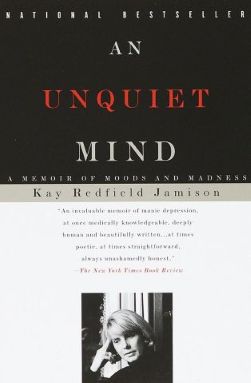
Books seem to come into my life when I need them (of course, this probably has something to do with the fact that I choose which books to read when!). I’ve had Kay Redfield Jamison’s An Unquiet Mind: A Memoir of Moods and Madness on my shelf for years but have long been afraid to dive in.
Dealing, as it does, with the highs and lows of Jamison’s manic depression (now called bipolar disorder, which I also am diagnosed with), I was worried it might be triggering or upsetting if I cracked it open while in the wrong frame of mind.
But, in a recent period of stability, I started reading Jamison’s memoir — a decision that, like so many of my moods, turned out to be a double-edged sword. “The Chinese believe that before you can conquer a beast you must first make it beautiful,” she writes. “In some strange way, I have tried to do that with manic-depressive illness…In order to contend with it, I first had to know it in all of its moods and infinite disguises, understand its real and imagined powers.”
She calls the illness “a distillation both of what is finest in our natures, and of what is most dangerous.” Indeed, for reasons unrelated to the book, I soon found myself once again grappling with a deep downward spiral, one of bipolar disorder’s dangerous distillations. Jamison’s words, much like the illness itself, were both pain and balm as I saw how some of her experiences ran parallel to mine.
“The morbidity of my mind was astonishing: Death and its kin were constant companions,” she reflects. “My memory always took the black line of the mind’s underground system; thoughts would go from one tormented moment of my past to the next.”
As someone who spends too much time rehashing meaningless interactions during which I fear I’ve blundered irrevocably — and, ironically, too much time trying to break that habit — I felt in complete sympathy with Jamison here. And although I’ve largely managed to relegate “death and its kin” to acquaintances rather than constant companions, macabre thoughts still knock on my mind’s door far more often than I’d like.
And yet, also like Jamison, I’ve learned to coexist with this illness that is part of my inheritance. My father, like the author’s father, grapples with unpredictable moods; my mother, like Jamison’s, has always been a steadying presence:
“It was as if my father had given me, by way of temperament, an impossibly wild, dark, and unbroken horse. It was a horse without a name, and a horse with no experience of a bit between its teeth. My mother taught me to gentle it; gave me the discipline and love to break it; and…she understood, and taught me, that the beast was best handled by turning it toward the sun.”
Some days, it’s more difficult than others to turn the beast (let alone myself) toward the sun. Yet it’s true that, like Jamison, I am discovering things that make it easier. Recounting the time she confided in a loved one about her illness, she writes:
“David could not have been kinder or more accepting; he asked me question after question about what I had been through, what had been most terrible, what had frightened me the most, and what he could do to help me when I was ill. Somehow, after that conversation, everything became easier for me: I felt, for the first time, that I was not alone in dealing with all of the pain and uncertainty.”
To my great fortune, I’ve had not just one but many people react this way: with support, with kindness, with patience, and with love. It is this love on which I draw during periods of instability like now — love, coupled with the knowledge (culled from miserable experience) that this, too, shall pass. As Jamison phrases it:
“My high moods and hopes, having ridden briefly in the top car of the Ferris wheel will, as suddenly as they came, plummet into a black and gray and tired heap. Time will pass; these moods will pass; and I will, eventually, be myself again. But then, at some unknown time, the electrifying carnival will come back into my mind.”
The trick is finding a way to live, as peacefully as possible, in all three states: the carnival, the charnel house, and the brief calm in between.
Mariko Hewer is a freelance editor and writer, as well as a nursery-school teacher. She is passionate about good books, good food, and good company.