The biographer talks Mary Kay, direct sales, and those signature pink Cadillacs.
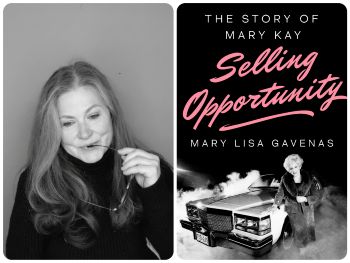
Author Mary Lisa Gavenas already knows what you’re thinking. It was exactly what I was thinking when I first met her at this year’s Gaithersburg Book Festival, and she told me about her biography of Mary Kathlyn Wagner, better known as Mary Kay. “The lady who gave away all those pink Caddies,” I said.
Big mistake.
In her deeply and thoughtfully reported book, Selling Opportunity, Gavenas uses Mary Kay’s rise (from a thrice-divorced, twice-widowed housewife selling cleaning products to neighbors to the first woman to chair a company listed on the New York Stock Exchange) to tell the story of the American Dream: one of self-reliance, bootstrap sensibility, and remarkable sales(wo)manship. And, okay, an Oprah-like flair for giving away cars to her audience.
You’ve said that Selling Opportunity takes a Studs Terkel-inspired approach to biography. Can you say a bit more about this and why your book might be a foil to other biographies on the subject of women and the American Dream?
Terkel focused on people who are normally invisible: people beneath the notice of traditional biographers. Working and Hard Times told American stories that had been overlooked. I wanted Selling Opportunity to work the same way. I wanted to hear what it was like to have two babies at the age of 18, to peddle door to door during the Depression, to be a wife who couldn’t write a check without her husband’s permission. I spent years tracking down testimonies because I wanted to hear the chorus behind the polished public voice of Mary Kay Ash.
What are people like me — who think of Mary Kay as just a pink-Caddy-awarding, Horatio-Alger-in-lipstick success story — missing?
This is a rags-to-riches story that fails to follow the usual plot. Mary Kay’s messy personal life included a latchkey childhood, teenage pregnancies, and being the breadwinner in five of six marriages. She was a grandmother at 34. Mary Kay glossed over almost all of that. She also did not set out to be an entrepreneur. With ambition aplenty and no place to use it, she became addicted to the praise and prizes and possibilities of direct selling. For years, she plugged away, convinced that hawking toilet-bowl brushes and E-Z Cleaner could make her dreams come true.
A new husband talked her into going into business with him — using her savings — in 1963. Then, he dropped dead. She was 45. As it turned out, the U.S. still had a surplus of women with ambition aplenty and no place to use it. Mary Kay knew just what to say to them.
What initially drew you to Mary Kay? Is there anything in her history that parallels your own (other than you also having two first names, with one being Mary!)?
It was a great story, and nobody had told it. I’ll admit that when I started this, I did not understand her life choices. I felt that I had to keep going until I did. When I knew more about midcentury, working-class women, some of her choices began to make sense. I might not agree with all of them, but I began to understand them.
Why do you think people love narratives about second acts and reinvention?
We’re raised to believe that anyone can make it if they work enough. We hear it in school, in church, in the media. America is the Land of Opportunity. That’s what makes the draw of direct selling so powerful: Recruits see it as a reset that requires minimal training and finance. Who doesn’t want to believe that life can change for the better?
You mentioned your disappointment that marketers began to push your book as one about beauty, or as a referendum on pink Cadillacs (which is such a great phrase!). How should they have regarded your book?
It’s business history. Mary Kay founded a company that made the Fortune 500. She was the first woman to chair a company on the New York Stock Exchange and the only woman included in Forbes Greatest Business Stories of All Time. Her marketing and managements strategies were the subjects of case studies at the Harvard Business School. Since there was no way to write about Mary Kay without writing about the evangelical capitalism that occupied her every waking hour, this became the first book to tackle the history of direct selling.
When we met, you told me that, before your book, most of what was out there about Mary Kay’s origin story was inaccurate. What’s the biggest fallacy about her?
Probably the biggest fallacy is that Mary Kay cooked up this business model for her own financial gain. One recent book, Little Bosses Everywhere, had Mary Kay inventing the recruiting-and-compensation structure that her sister-in-law began using in 1957, which, even then, was a refinement of what other companies were doing.
Another popular fallacy: Mary Kay forced recruits into huge buys that they could not afford. At the start of her company, she accepted only cashier’s checks or money orders: no personal checks, no credit cards. Although she did her damnedest to convince consultants to make big buys, saying, “You can’t sell from an empty wagon” and beguiling them with sales prizes, she was wary of losing consultants to debt and conscious that their husbands would object. From 1970 onward, a recruit could return unused products within one year of purchase and get 90 percent of her money back. However — then and now — many women never attempted returns. Some became embittered, enraged, or embarrassed. Some still hoped to give it another go.
Cathy Alter is a member of the Independent’s board of directors and the author, most recently, of CRUSH: Writers Reflect on Love, Longing, and the Power of Their First Celebrity Crush.