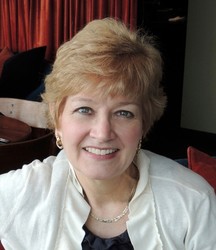
The novelist talks edges, the Holocaust, and never losing her voice.

Elizabeth Poliner’s Spinning at the Edges is an intergenerational novel set in two time periods — Amsterdam in 1941 and the United States in 2000 — that fuses history and heartbreak. It has been dubbed by Pulitzer Prize-winning author Edward P. Jones as “simply, a marvel,” and National Book Award winner Alice McDermott calls it “an absorbing story of entangled lives — a meditation on grief and justice, the weight of the past, and the dizzying uncertainties of the future.”
Poliner left law practice behind decades ago for the literary life. Her novels include the prize-winning As Close to Us as Breathing, her short fiction and poetry have been published in prestigious reviews, and she’s been awarded numerous grants, fellowships, and residencies. She has long taught creative writing, most extensively at Hollins University, as well as at American University, George Washington University, the Smithsonian, and the Writer’s Center in Bethesda, Maryland.
How did the novel’s title come to be?
For a long time, Edges was my working title. I was thinking about edges literally, including the edges of skates, but also as a metaphor for the edges of love, maybe the edge of democracy. With time, the title became Spinning at the Edges to better capture the breadth and feel of the novel. There’s a lot of physical spinning in the novel, such as spinning on skates, but there’s also emotional spinning, which most of the characters do in their own way. In the 1941 backstory, there’s also a government that’s spinning out of control, and there’s just a hint of the possibility of that in the year 2000.
Faulkner said the seed for The Sound and the Fury was an image of a girl’s muddy drawers as she climbed a tree to look in a parlor window. What came to you first for this book?
I was in my study one evening, and Stephanie Pearl simply arrived in my mind, and with several distinct attributes: a terrible loneliness connected to her mother and a few good childhood memories of ice skating with her mother. That was the seed to all that followed.
Did your treatment of Jewish characters and Jewish issues come forward organically, or was it more constructed?
The story didn’t involve Jewish history until — years after Stephanie Pearl “arrived” — I discovered who her mother was. That process began one evening when I was out with some friends. One was the son of two Holocaust survivors, and he was telling us about his mother, a competitive swimmer who suddenly had to stop her training because Jews couldn’t swim with others anymore. Having been a swimmer myself, and Jewish, that story woke me up, which is perhaps why the next part hit me so deeply.
We were told that the family went into hiding, but a female relative chose to slip out every so often to take a bath. Doing this, she was ultimately arrested and lost her life. For some time afterwards, I kept thinking about why a person would knowingly put herself at risk and started answering that imaginatively (e.g., she wants to be at risk because she’s despairing), and pretty soon, I had the tragic character Sophia. I then realized Sophia had a surviving sister, and that this person was Stephanie’s mother — someone who keeps her traumatic past to herself, which is why Stephanie can’t connect to her. That’s what brought the Holocaust into the novel.
Tell me about your visits to Amsterdam.
I spent my first trip getting a feel for what it was like there during that past time. I went to museums, such as the Anne Frank House and the Jewish Historical Museum, and I walked a lot and took photographs. I was amazed at how accessible the past was, as if the streets of Amsterdam were haunted. The second trip focused more on people there. Most notably, I interviewed a Holocaust survivor whose lingering pain — acute anxiety — was untreatable. That afternoon, I found myself helping her in any way I could, and for those moments, it was as if I’d become my character Stephanie, doing all she can for her Holocaust-surviving mother.
You went to law school before you began your writing career. How did that affect this book?
The awareness we gain as to the role law plays in our lives may be the big takeaway from law school relative to this book. When Stephanie came along in 2000 during Bush v. Gore, a story began developing with that case as a backdrop. Later, the very first scene I wrote in Amsterdam involved anti-Jewish Nazi laws. I guess you could say I pay attention to law, which I’m sure comes from having studied it.
You move back and forth among times and places in the novel, but it’s always easy to follow. How did you create that structure?
I did it intuitively, but to follow the evolving structure — which became intricate — I created a storyboard using Post-It notes for every point-of-view section in a chapter, which allowed me to see the structure and fuss with it. In the text, I was always careful to mark time transitions upfront, which makes them clear, and much of the story within the two time periods moves linearly, which helps with grounding the story.
Although you grapple with big topics in the book, such as inherited trauma, human longing, and the misuses of law, the prose is a pleasure to read. Does it come naturally as you write?
I begin a day’s writing by reading over, often out loud, what I did the day before, and that habit begins the process of line editing as well as getting me back imaginatively into the story. Beyond that, though, sentences are constantly worked over throughout the revision process. And at the very end, I spend more time tightening them, several rounds of that. By the end, the language is pretty worked over, but it never loses the sound of my voice.
Bert Brandenburg lives in Silver Spring, Maryland.