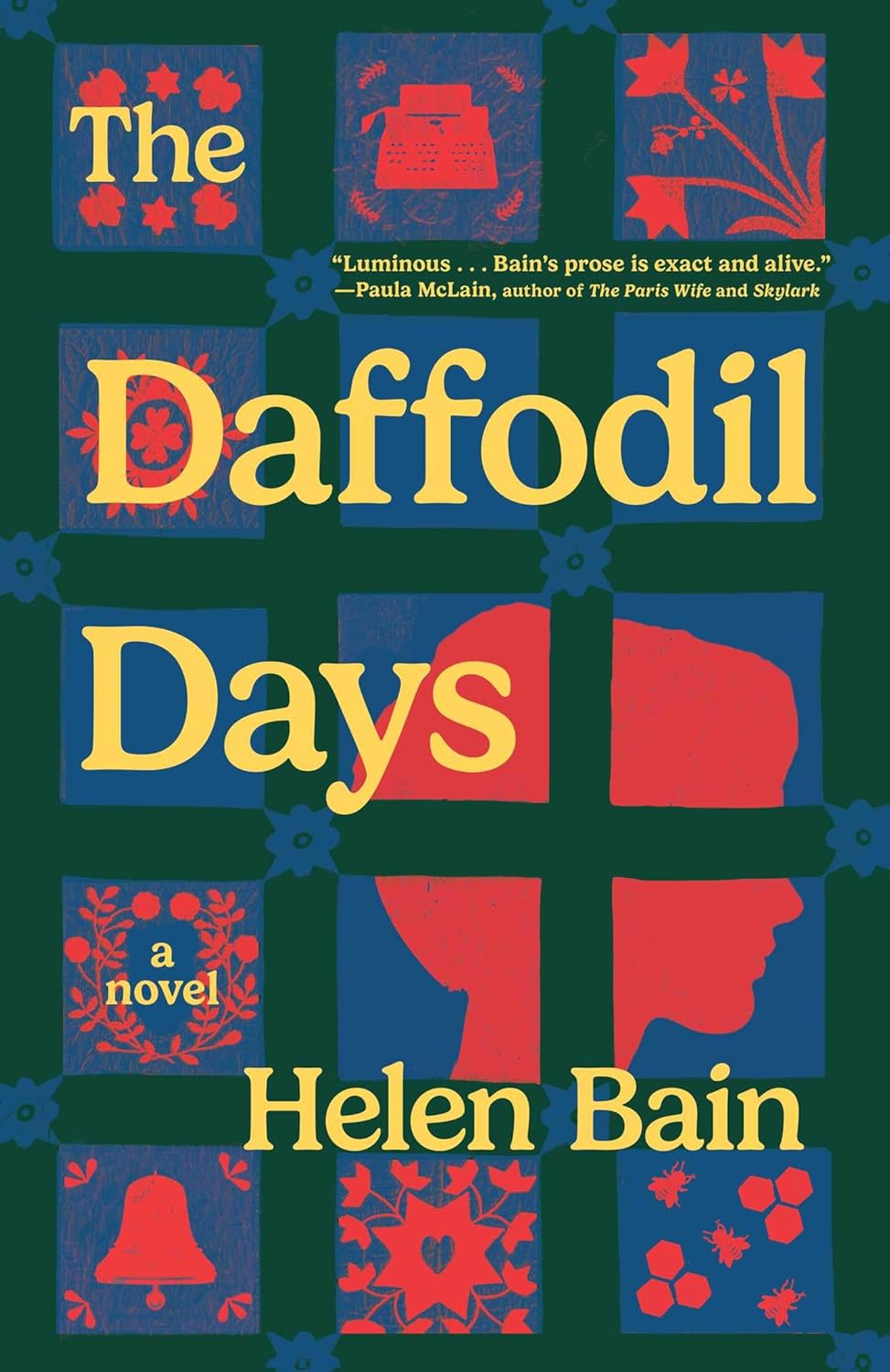
The Daffodil Days: A Novel
- By Helen Bain
- Scribner
- 304 pp.
- Reviewed by Samantha Neugebauer
- July 14, 2026
An affectionate reimagining of Sylvia Plath’s domestic life.
One complaint I often hear about contemporary fiction is fatigue with protagonists who are writers or writer-teachers. Embedded in this criticism is the implication that the authors of these books lack the imagination, experience, curiosity, or research acumen to install their characters in convincing alternative professions.
In contrast, other readers (often reader-writers) flock to such narratives, liking how they cut away some fat to make parts of the story emphatic (a bit like how Ben Lerner or W.G. Sebald include photographs in their text so readers can save their imagination for other things). Meanwhile, social media, especially in the form of short reels, is chockfull of videos of people engaged in all sorts of labor. Just this morning, I watched a satisfying clip of someone repairing a tear in leather car upholstery.
In Helen Bain’s debut novel, The Daffodil Days, you get the best of both worlds. Ostensibly, the book is a work of historical fiction that reconstructs the final year of Sylvia Plath’s life in the small town of North Tawton, Devon, in South West England. Except this isn’t a straightforward story with a writer protagonist. Each chapter is told from the point of view of either a North Tawton resident or an outsider connected to Plath’s family.
The townspeople are fantastic characters. Through them, a compressed “Slow TV” effect — a kind of occupational voyeurism — is enacted, with Bain’s eye lingering on the everyday work of a rural maid, a doctor, a saleswoman, a washing-machine installer, a church-bell ringer, and others. But never on Plath. Never on her writing. There’s a sense that Bain is laying out the raw materials of Plath’s final setting like a train-platform village and then moving Plath around it, guessing at how she might’ve fit in or not.
I took deep pleasure in reading about the minutiae of labor and the townspeople’s undeniable expertise. It had a calming effect:
“She shakes the duster out of the window, leaving it open, and goes along the corridor to the front of the house…She dusts the chest of drawers, and unclips the tin of polish, smearing some on the cloth and dabbing it lightly across the wood surface before rubbing it in well.”
If not endless time, there certainly seem to be more hours in the day in this world than in ours. Of course, that’s not really true; it’s only that our sense of time has been distorted by constant connectivity.
Plath’s own knowledge of the domestic arts shines as well. In one instance, the washing-machine installer is instructing her on how to use her new Bendix — “A mix of smaller and larger pieces gives a better result than all large” — when Plath breaks into a story about her troubles removing dirt from her daughter’s play clothes:
“It’s impossible to get out without bleaching…Here it’s good healthy soil, but it’s difficult to get out of wool. So instead of having to keep a tub soaking each night and then hand-washing every morning, I’m making her up with little cotton smocks. Really tough fabric I can put in the machine. I’ve got a sewing machine…”
What’s interesting is that if you know about the poet’s personal life (Heather Clark’s Red Comet: The Short Life and Blazing Art of Sylvia Plath is the crème de la crème of Plath biographies), then you know this year in Devon was particularly tough and isolating for her. It was, after all, the year that spelled the end of her storied marriage to Ted Hughes. And the year that Plath’s writing schedule fell apart, due to the birth of her second child, among other calamities. Yet, in many ways, compared to the precarity of writers’ lives now, this one seems like a dream. Bain’s descriptions of Devon’s flowers and moors, as well as of the Hughes’ orchard and bees and train trips to record poems for the BBC, are enough to make any author swoon. It’s all very lively and idyllic.
Nonetheless, a chapter called “The Jaeger Suit,” told from the perspective of Jenny, a local girl working in a boutique, reminds readers of the hierarchies that can define a smalltown life. I would read a whole novel about Jenny, who dreams of moving to London, who is beleaguered by her fussy boss, who is not afraid of mice like the other girls (“On a farm you fall asleep every night to rats running up and down the rafters”), and whose friend Chrissie is already in London — working in a dressmaking court — due to a connection of her mother’s. “Jenny’s needlework was just as good as Chrissie’s if not better, but the lady didn’t see her book.” Jenny then helps Plath select a dress, sending her to a competing shop beyond the town.
The novel is clearly well researched; For the Plath aficionado, Easter eggs abound. It achieves a singular feat with its polyphonic structure and reverse chronology, the latter which I found more distracting than stimulating. Still, it holds its own on a crowded shelf of other commendable homages, including Catherine Bowman’s The Plath Cabinet, a poetry collection looking at Plath’s material artifacts; Penny Zang’s recent novel, Doll Parts, about friends in a Sylvia Club; or Hughes’ own collection of poems about their life together, Birthday Letters. On nearly every page of The Daffodil Days, you can feel Bain’s love and admiration for Plath. Her novel does, however, make one reflect on the difference between historical fiction and fan fiction.
Although no one has quite articulated the historical world around Plath before, after Clark’s magical biographical feat, it’s hard to add more to the Plath canon. And yet, Bain’s urge to do so is understandable. Ultimately, this novel is for the Plath devotee who will always want more of her, the one who is not choosing between this, the Clark biography, The Bell Jar, the journals, or the original poetry. For true fans, The Daffodil Days succeeds at keeping Plath alive in our minds for another day and from an entirely new direction.
Samantha Neugebauer is the author of the forthcoming short-story collection Villains (WWPH, January 2027) and hybrid craft-pedagogy book Teaching Writing Through Story Reimaginings: Adaptation as Critical Practice (Bloomsbury, 2028). She is a lecturer at NYU in DC, a senior editor at Painted Bride Quarterly, and co-host of the YouTube short-story review channel “Short Story Boudoir.”