The Beasts of the East: The Fall and Rise of America’s Eastern Wilderness
- By Andrew Moore
- Mariner Books
- 432 pp.
- Reviewed by Dennis Drabelle
- July 13, 2026
An edifying look at efforts to rewild parts of the U.S.
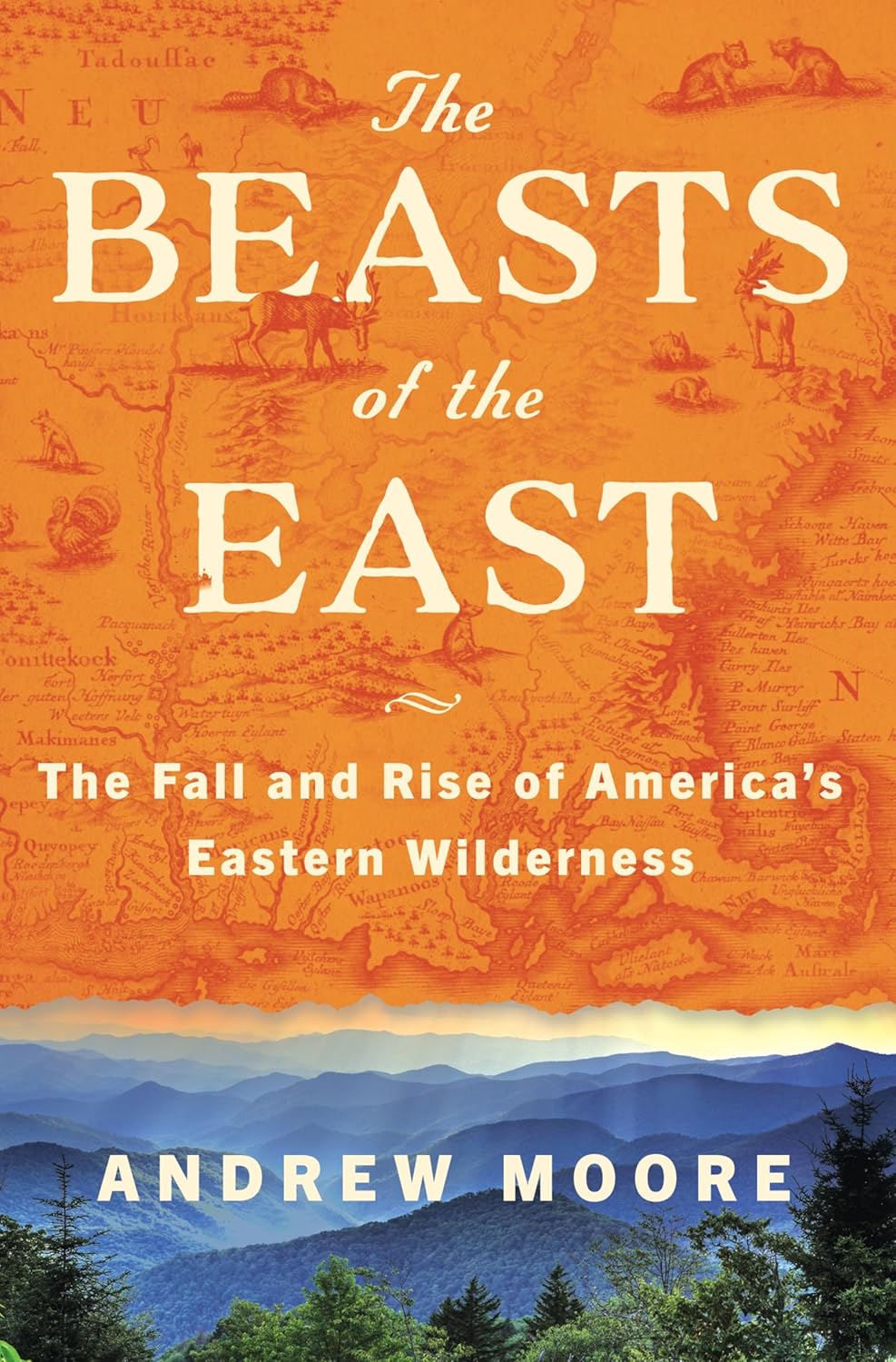
One day in the fall of 1986, a caretaker was feeding red wolves in captivity at North Carolina’s Alligator River National Wildlife Refuge. When he “went to throw food into a pen, a wolf lowered its head and wagged its tail…” What layfolk might have taken for a meet-cute, however, was worrisome to the caretaker. The tail-wagger belonged to a cohort of wolves slated for release as part of a program to reintroduce the species to the eastern United States. If the creatures were to survive on their own, they had better stay as wild as possible — thus, no bonding with humans. The caretaker’s reaction to the wolf’s kowtow was spontaneous and, one hopes, effective. He snarled at it.
That bit of strategic rudeness is one of many colorful details folded into Andrew Moore’s new book, The Beasts of the East. In addition to the red wolf, he profiles two other candidates for comebacks in places where they once flourished: elk in Kentucky and bison in Illinois. Predictably, none of the efforts has lacked for controversy, and the suspense of finding out how they panned out keeps the book’s pages turning.
Why go to all the trouble and expense of bringing wild animals back to habitats they were hunted or crowded out of decades, if not centuries, ago? The answer varies from beast to beast. Among elk’s virtues is majesty: People enjoy hunting or simply gazing at them in wonder, and elk tourism has brought needed jobs and revenue to the Kentucky Appalachians. Bison, which Illinoisans had done without for almost 200 years, churn up the soil so that it can play host to a diversity of flora.
As apex predators, wolves enrich ecosystems that have lost their primordial complexity — and in nature, “more complex” generally means “healthier and stabler.” There was also a widespread conviction that a tame East was impoverished, an indictment of our forebears for destroying so much of our wild heritage. And in the context of global warming, Thoreau’s pronouncement that “in wildness is the preservation of the world” rings truer than ever.
In some ways, the elk project has been the biggest surprise of the three. Elk are now holding their own in a realm once written off as an ecological wasteland: the denuded mountaintops of strip-mined Kentucky, reclaimed — in essence, replanted — by mining companies under legal obligation to do so. Flying over the area one day, a pilot who’d taken part in reintroducing whitetail deer to woodlands had an aha moment: Why not do the same for elk in these rehabbed heights?
Luckily, the animals proved tolerant of the blasting at still-operating mines nearby. “The elk would look out toward the commotion,” Moore writes, “and then lower their heads and keep on grazing.” The Kentucky success became one for other Eastern states to envy and emulate.
The near-extinction of bison, not least by sharpshooting Buffalo Bill Cody himself, is a well-known tale of American hubris and neglect. It took 40 years and the restoration of the Nachusa Grasslands, a prairie owned by the Nature Conservancy, to provide suitable habitat for the big ungulates in Illinois, where they’re doing well despite being confined to 3,800 fenced-in acres and, hence, prevented from roaming freely, as is their wont.
The red-wolf program has been the thorniest and most contested of all. Biologists waged a long, testy debate over the creatures’ taxonomic status — separate species or hybrid of wolf and coyote? (The separatists ultimately prevailed.) North Carolina officials have waffled in their support of the reintroduction. (For now, they’re pro.) And some local folks just can’t get over their visceral loathing of wolves. Yet the critters are hanging in there.
Moore is an uneven stylist. He can be evocative and funny, as when he notes the difficulty of persuading the restored Nachusa’s managers to accommodate bison. They were being asked “to put a 2,000-pound grazing, wallowing, defecating, herd-forming, wild animal in the middle of their painstakingly curated tapestry.” But he is a frequent dangler of participles, as in “Sprawling over more than 40,000 acres, the U.S. Army had recently declared that more than half of the land was in ‘excess’ of its needs.” Shame on the Army for sprawling on the job.
The author is also addicted to the helping verb “would,” as in this passage about Arizona’s Kaibab Plateau: “As early as 1920, biologists noted that there were suddenly too many deer for that arid habitat. In 1924, Aldo Leopold would visit the Kaibab…” But the great environmental thinker and writer didn’t “would visit” the Kaibab; he flat-out visited it. This sort of thing is all right in small doses, but it crops up hundreds and hundreds of times in The Beasts of the East, causing the reader to wonder what the author has against the indicative mood.
Nonetheless, the years Moore spent gathering information and interviewing experts have paid off. The Beasts of the East makes for thought-provoking and heartening reading.
Dennis Drabelle, a former contributing editor to the late Washington Post Book World, lives in Asheville, NC, a city shared by humans and black bears.