Talking Classics: The Shock of the Old
- By Mary Beard
- University of Chicago Press
- 208 pp.
- Reviewed by Gabrielle Stecher Woodward
- June 24, 2026
An erudite exploration of antiquity’s allure.
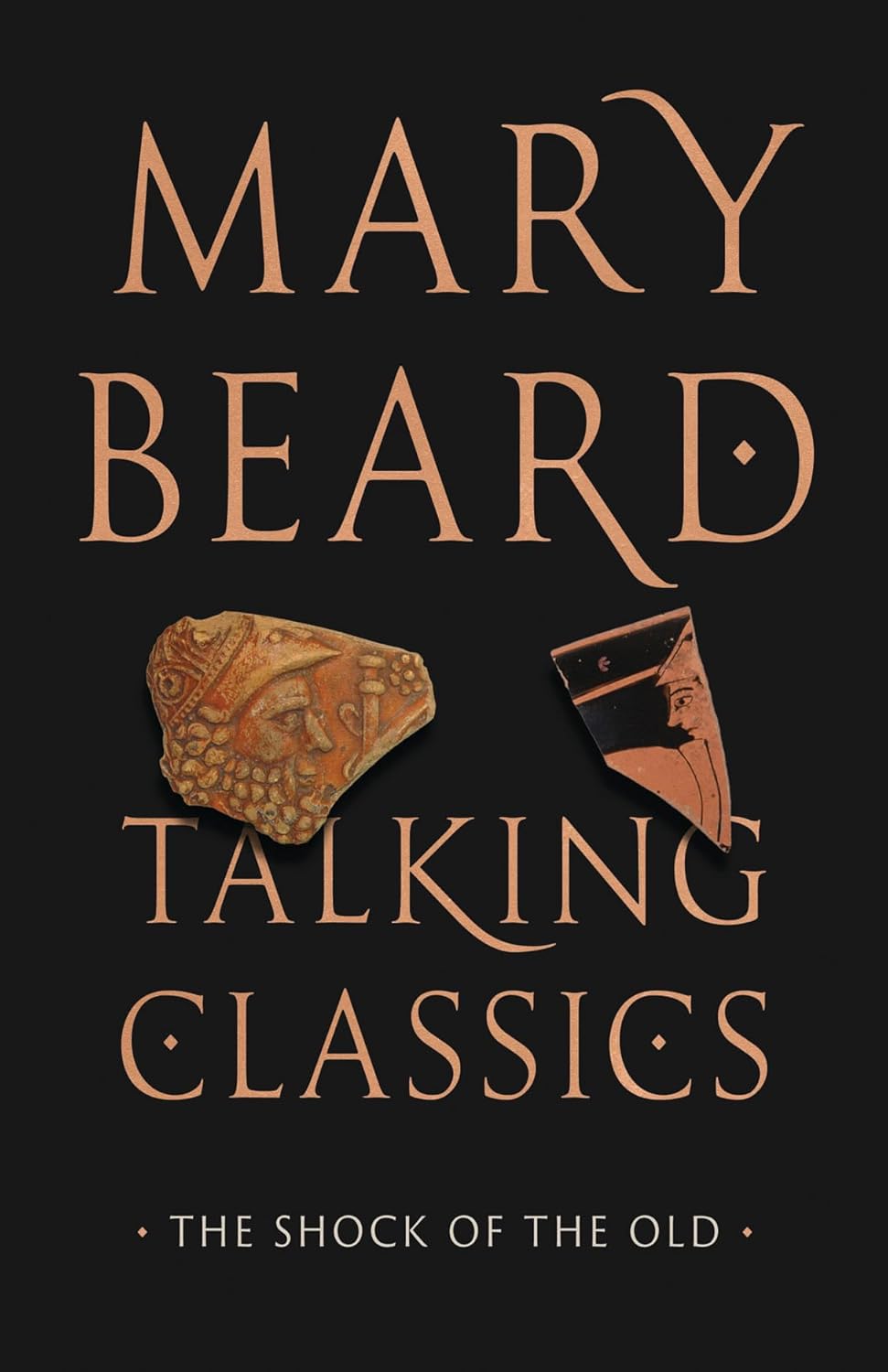
In Talking Classics, Mary Beard does what she has long done best, modeling fresh ways of thinking about antiquity that are as welcoming as they are insistently reflective. As the acclaimed classicist guides us from the hilarious and duplicitously relatable cartoons painted on the walls of a Pompeian bar to the sobering, fascist archaeology of Mussolini’s Rome, she presents a persuasive, metacognitive call to action.
For Beard, classics represents not an idealized world worthy of untempered admiration but an invitation to think critically, perhaps for the first time, about the allure of antiquity on an individual level. Why does the classical world move us still? And why do we each seem to have our own unique stories to tell about those first private moments of recognition, when we realized there is something undeniably seductive (for better and for worse) about ancient Greece and Rome?
Like the best teachers, Beard doesn’t ask readers to do any intellectual work that she’s unwilling to undertake herself. Thinking alongside rather than talking down to her audience remains a central source of her appeal to armchair classicists, interdisciplinary scholars, and aspiring historians alike. Much of what distinguishes Beard as a grand dame of public humanities lies in this refusal to gatekeep: She treats the classical past as a realm accessible to anyone inclined not just to wonder but to “look our demons in the eye.” No doctorate required, simply a willingness to take antiquity’s beauty and its ugliness in stride.
Where Beard’s 2013 Confronting the Classics: Traditions, Adventures, and Innovations offered a masterclass in the arts of book reviewing and making debates about antiquity legible to wider audiences in real time, Talking Classics shifts the emphasis inward, inviting readers (no matter their professional or personal affiliations) to reconsider how they perceive and participate in the divide between past and present.
Notably for the author, the Greeks and the Romans are not ours to own, and she refuses to perform the role of the sclerotic, unduly possessive academic. Classics is too vibrant a subject — too much “a moving target” continually reinvented by new readers and global perspectives — to be restricted in this way. It is precisely because “classics belongs to none of us,” she suggests, that it can function as “a safe space to argue about the most difficult debates we face now — from race to sexual violence and gender identity.”
If you’re looking to take a page from Beard’s playbook for defending the humanities, look no further than this volume. Though Talking Classics stops short of offering the kind of “coherent manifesto” that we might expect from the usual “niche books written explicitly in [the humanities’] defense,” her reflections on what classics teaches — namely, how to read carefully, think critically, and sit with (rather than rush through) antiquity’s myriad contradictions — are refreshing and disarmingly honest, as she, too, concedes that “in teaching, you don’t win ‘em all.”
A genre hybrid, Talking Classics contains just enough of Beard herself to scratch the memoir itch, at least a bit. Its central image is that of the classicist as a young girl, her eyes opened by a piece of Egyptian bread thousands of years past its expiration date and a generous curator in the British Museum willing to grant her access to it — a moment that captures the wonder inherent in classical studies. Equally important, though less foregrounded, are Beard’s status as a woman in the discipline and the uneasy journey required to establish her voice in a male-dominated field, both inside and beyond the ivory tower.
Reflecting on “the struggles I had in discovering what a woman’s voice in classics, whether spoken or written, sounded like, and in learning how to convey to other people my own excitement with the ancient world,” Beard reminds us that enthusiasm is not to be taken for endorsement. In this sense, Talking Classics should be required reading not only for aspiring classicists but for anyone pining to become a public historian or to participate more thoughtfully and authoritatively in these conversations.
Gabrielle Stecher Woodward is a writer, critic, and award-winning educator. She earned her Ph.D. in English from the University of Georgia, where her research focused on historiography, reception, and the cultural afterlives of the ancient world. Her subsequent work interrogates the stories we tell about women artists from antiquity to the present, and her writing has appeared in American Book Review, Harvard Review Online, Film Quarterly, and Woman’s Art Journal, among other venues.
