Raps of Resistance: How Kendrick Lamar and J. Cole Reignited a Hip-Hop Tradition
- By Jeremy C. McCool and Earl Hopkins
- Bloomsbury Academic
- 232 pp.
- Reviewed by E.A. Aymar
- July 2, 2026
A persuasive case for the primacy of two singular artists.
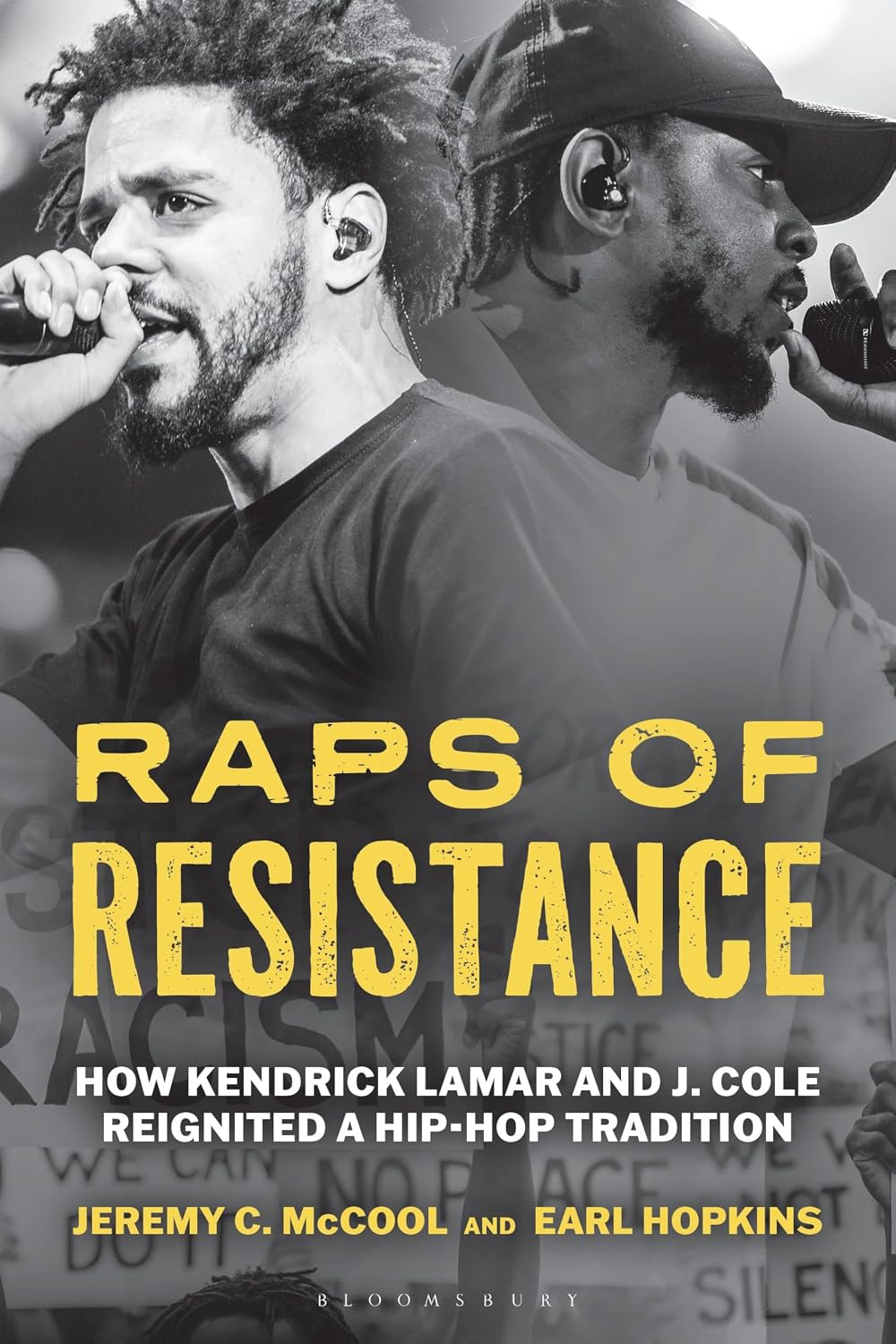
Raps of Resistance: How Kendrick Lamar and J. Cole Reignited a Hip-Hop Tradition goes far beyond its subtitle. More than simply a celebration of the two titular, iconic rappers, this study by professor Jeremy C. McCool and journalist Earl Hopkins is an unvarnished exploration of the history of hip hop (both the good and the bad), the importance of the tradition, and how the music has grown into a global phenomenon. Along the way, the authors nimbly detail how Lamar and Cole emerged from that tradition and how their music represents — as the authors firmly believe — the right path for its future.
For devoted fans of rap, much of that history will be known, but the authors’ retelling still makes for an enlightening read. Possibly informed by Hopkins’ background as a reporter for the Philadelphia Inquirer, the authors write in compelling, mercifully non-academic prose that efficiently covers the genre’s record-spinning origins in the grimy streets of 1970s New York, the variety of its forms and regional influences, and its current worldwide acclaim.
Along the way, the histories of Lamar and Cole are similarly explored. Although Lamar — riding high from the Pulitzer in his back pocket, the recent evisceration of his rival, Drake, and a Super Bowl performance — has eclipsed Cole in influence and fame, both are perfect antidotes to the authors’ contention that popular rap has strayed from its important foundational elements and has become, as they state in their preface:
“…an oversaturation of untalented emcees and online personalities-turned-musicians, who refuse to rap about the social, cultural, or political issues affecting real people, especially those in the very communities or enclaves they came from.”
Their complaint isn’t uncommon in hip-hop circles, but that doesn’t mean it’s not valid. And if you share it, then you, too, may see Lamar and Cole as rap’s necessary saviors. Both have achieved mainstream success with seemingly little compromise. And both have a history of addressing social causes such as the debilitating effects of mass incarceration, wavering mental health, the nihilistic attraction to violence and crime, and the trappings of lust and sex. Beyond that, both write openly about the Black experience. And, as the authors assert, “Black expression is the heartbeat and pulse of American music.”
Lamar and Cole have become two of the foremost documenters of the current American landscape. And their version of rap, defined in the 1990s as “conscious rap,” veers away from some of the criticism the genre has received but is no less controversial. Conscious rappers “tend to speak,” McCool and Hopkins write, “to the negative outcomes caused by the behaviors or circumstances, instead of glorifying the behaviors themselves…It’s not a weaponization of truth, it’s a platform of change with artists serving as its very agent.”
Like any definition of eras or movements, the artists don’t easily fit into this one, but Raps of Resistance makes a convincing argument that Lamar and Cole have, at least, heavily borrowed from the tradition of conscious rap to further their music. In the authors’ telling, the personal histories of both — Cole, college-educated and raised in North Carolina, and Lamar, a high-school graduate who grew up in Compton — are informed as much by the changes in hip hop as by their families, neighborhoods, and sociopolitical landscapes. They go on to discuss the influence of crime in the men’s youth all the way up to the effects of racism from the Trump administration.
The current landscape, in the authors’ estimation, is bleak both for the U.S. and for rap music, with the former’s cultural capitalism often undoing the latter. “Prolific emcees with powerful messages are shelved and overlooked by labels, while lesser talent is encouraged to push negative stereotypes about Black people for profit,” they contend. “Hip-hop music and culture have become overly commercialized, and are now being treated like the profitable commodities they are.”
This mirrors the exploitation of Black music throughout this country’s history, which the authors address in their closing pages as they ponder the future of rap and whether Cole and Lamar are examples of its final movement.
Still, I have some quibbles with the book. For as much stage time as Lamar and Cole are given, we’re generally told, not shown, how transcendent their music is. The authors frequently write about a topical issue — such as the 2016 election or the sexism women face in hip hop — and touch on how the two rappers have addressed it. But rather than being given a brief highlight on how a song has discussed politics or misogyny, I would’ve preferred a deep dive into the lyrics, particularly those from Lamar, whose songs often feature “layered storytelling, intricate wordplay, and advanced vocabulary” and have “encouraged academics to study and teach [them].”
It’s not just academics. Like Taylor Swift nowadays or yesteryear artists like Bob Dylan or Gil Scott-Heron, fans dive down rabbit holes dissecting Lamar’s lyrics. It’s a missed opportunity that the authors don’t occasionally do the same.
Most rap enthusiasts would agree with Raps of Resistance’s central premise, that the mic skills and social focus embodying Lamar’s and Cole’s music are regularly overshadowed by chart-topping mediocrity. But isn’t that a feature, and not a bug, of any artistic tradition? Greatness, by definition, is always the exception.
Similarly, the standards of greatness change. I can remember when NWA was reviled (and not only by conservatives), only to later be reimagined as cultural heroes, such as in 2015’s glossy, intentionally forgetful biopic “Straight Outta Compton.” Who’s to say that today’s most popular mumblecore rappers, derided by purists but popular with casual fans, won’t likewise be considered visionaries 20 or 30 years from now?
God, I hope not, but I don’t make the rules.
There’s also only passing mention here of one of the most important components of rap: its vibrant underground scene, which often features artists who appreciate and embody the traditions the authors praise, and from which Lamar emerged. If any rappers whose music follows the patterns preferred by the authors (and me) are going to be appreciated in the future, there’s a good chance they’ll come from independent labels like Rhymesayers, Beatrock, Strange Music, Stones Throw, or Mello Music. It wouldn’t have made sense for Raps of Resistance, with its focus on Cole and Lamar, to explore these indies, but it’s important for readers to know that socially conscious, artistically determined outlets exist.
But these are observations, not complaints. As someone who’s grown up devoted to rap and has witnessed its volatile shifts and seen its titans and subgenres come and go, I believe Raps of Resistance is a necessary addition to any fan’s library. McCool and Hopkins have provided a worthy offering to a culture that has given so much to so many and that continues to evolve in unexpected, powerful ways.
Booklist wrote, of multiple Anthony Award-nominated E.A. Aymar’s most recent thriller, When She Left, “This would appeal to fans of Elmore Leonard…with high-stakes violence tempered by humor and disarmingly sympathetic antiheroes.” In 2025, When She Left was chosen by PEN/Faulkner as one of three books for their prestigious DC Reads program. A former contributor to the Washington Post, Aymar is a former member of the national board of the International Thriller Writers and an active member of Crime Writers of Color and Sisters in Crime. He was born in Panama and now lives and writes in the DC/MD/VA triangle.