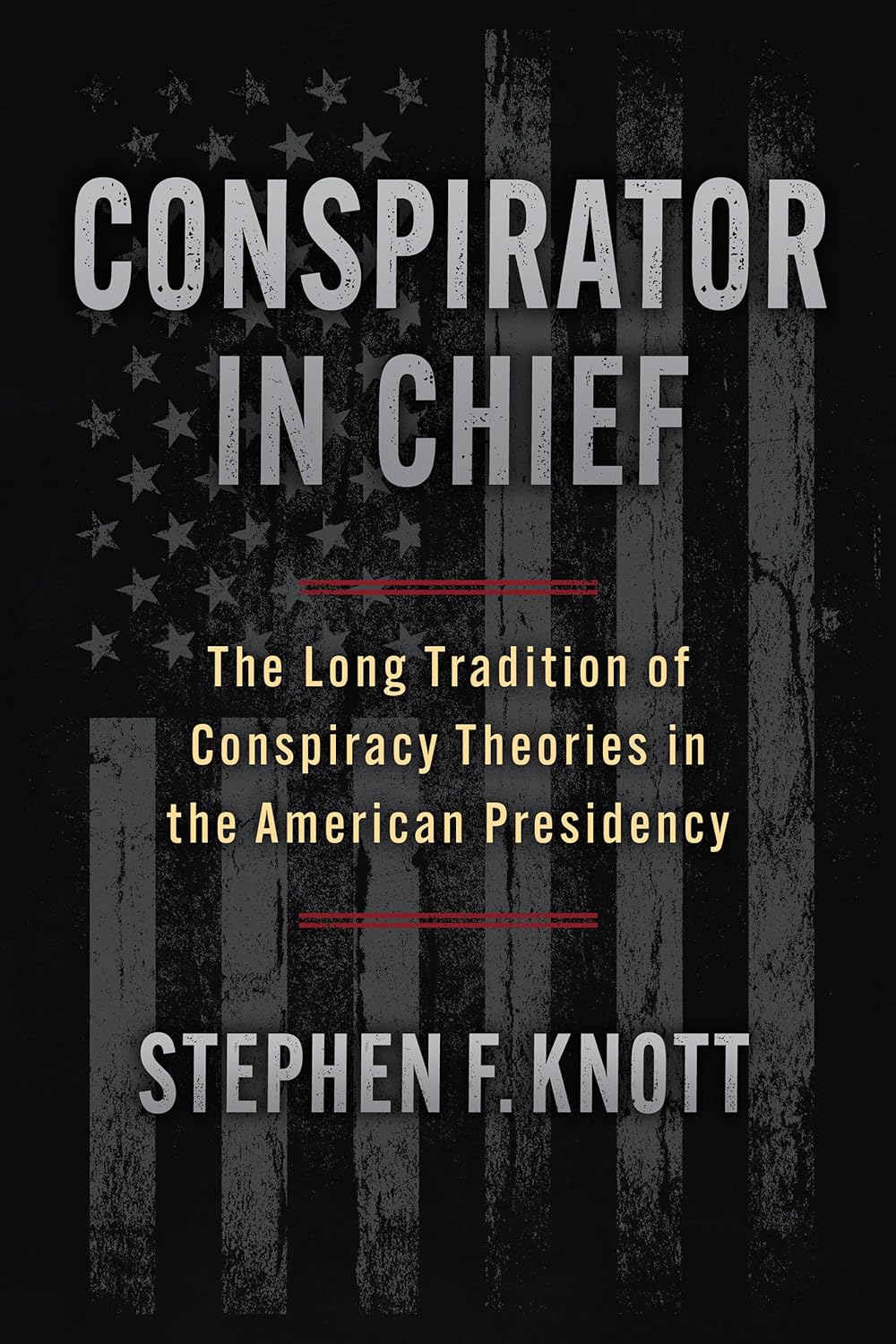
Conspirator in Chief: The Long Tradition of Conspiracy Theories in the American Presidency
- By Stephen F. Knott
- University Press of Kansas
- 240 pp.
- Reviewed by Eric Dezenhall
- June 22, 2026
The rumor mill is as old as our boisterous republic.
When we think of conspiracy theories, it’s easy to wrongly assume they’re a byproduct of our squalid age of tech-fueled disinformation. The notion of, say, an esteemed Founding Father like Thomas Jefferson or an antebellum swashbuckler like Andrew Jackson industrializing vicious junior-high gossip doesn’t ring true. The harsh reality of pernicious political gossip, however, is demonstrated in Stephen F. Knott’s primer, Conspirator in Chief, with clear, indisputable evidence.
Jefferson, despite his reputation for intellectual sophistication, could be nasty as a viper, portraying Alexander Hamilton as a monarchist who’d been running a criminal enterprise while serving as secretary of the Treasury. Hamilton was cleared of such malfeasance, but Jefferson, who saw him as an enemy of his agenda, was successful in broadcasting Hamilton’s extramarital affair, which led to a blackmail scheme that seriously weakened the statesman.
The monarchist conspiracy theory resurfaced during the political battle between Jackson and John Quincy Adams. In their first contest for president, Adams defeated Jackson in a congressional vote that Jackson railed was stolen. (Sound familiar?) In the subsequent election, Jackson tagged Adams as a cheerleader for British royalty, and, yes, people believed it. Jackson won.
Similarly, President Andrew Johnson leveraged the resentment of poor Southern whites to slow the pace of Reconstruction by framing his opposition as being under the control of “negro supremacy” plotters, which begs the question of how Black slaves managed to seize control of the republic within months of their freedom. Still, conspiracy theories don’t demand logic or proof, only resentment.
Moving into the 20th century, neither Franklin D. Roosevelt nor Harry S. Truman shied away from conspiracy theorizing. Roosevelt wrapped up smears against opponents who questioned his exercise of executive power — calling them “privileged princes” — in the warmth of his fireside chats. He even ordered the FBI to spy on hostile newspaper owners. Truman, likewise, whipped up a frenzy against his critics by framing them, Knott writes, as highly organized “bloodsuckers with offices in Wall Street.”
Richard Nixon’s psyche was famously fueled by conspiracy theories — and he wasn’t always wrong. The John F. Kennedy campaign juggernaut really was out to get him, and it likely stole the 1960 election. Nevertheless, it was easy to sell Nixon on promoting notions of an enemy cabal. “I think the antisemitic thing can be…very helpful to us,” he once said, encouraging aides to slime his foes as a Jewish coven and demanding an investigation of prominent Jewish Democratic donors. Donald Trump, of course, has perfected conspiracism into an historical crescendo by using social media, something his predecessors could’ve only dreamed of.
Knott is hard on conspiracy-mongering, and, morally, I agree with him. Yet in realpolitik, trafficking in conspiracy theories works, and to accomplish certain objectives, leaders sometimes must “enter into evil,” as Machiavelli said. There is no more effective way to do this than to launch a conspiracy theory because people believe them — and demand them. The author acknowledges this by citing Jefferson’s outlook that “destroying the reputations of an ‘elite’ group of opponents by circulating unfounded conspiracy theories was a small price to pay for securing [his] vision.”
Do conspirators-in-chief believe what they’re spreading, or do they just cynically deploy fanciful plots to achieve their goals? My read is that Knott supports the notion that presidents buy much of what they’re saying, such is the personal offense they take at their opponents’ barbs. Still, certain presidents were less inclined toward the cult of legerdemain, including George Washington, Abraham Lincoln, Calvin Coolidge, and George W. Bush, the latter of whom worked overtime to ensure American Muslims weren’t demonized in the wake of the September 11th attacks.
According to Knott, presidential conspiracies tend to share a few common features. First, there is a thin-skinned chief executive who believes rigidly in his destiny and agenda and views his enemies as uniquely evil and capable of unfettered mendacity. Second, there is always an alleged uber-elite club of plotters who can coordinate massive schemes undetected. Third, conspiracy-mongering requires loyal surrogates and media that insulate the president from culpability — the irony being that disseminating conspiracy theories is, in fact, itself a conspiracy.
Integral to the “shadowy elites” construct is the idea that dark forces are stealing from decent and defenseless people something that is rightly ours — and only the current president can deliver your birthright back to you. On this score, Trump has no peer.
With the metastatic rise of social media, conspiracism is not only here to stay but poised to worsen because each wing of the political horseshoe believes the other is solely responsible for the phenomenon. Yet Knott’s book doesn’t have to oversell what’s coming; it provides detailed building blocks that demonstrate how we got here.
Eric Dezenhall is the author of 12 books of fiction and nonfiction, including, most recently, Wiseguys and the White House: Gangsters, Presidents, and the Deals They Made.