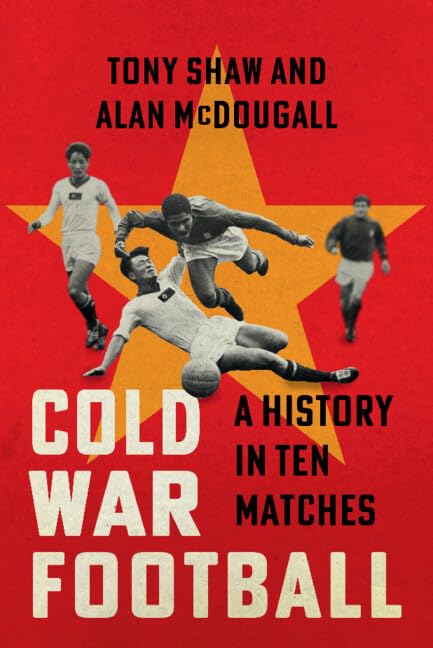
Cold War Football: A History in Ten Matches
- By Tony Shaw and Alan McDougall
- Cambridge University Press
- 284 pp.
- Reviewed by Janet Hook
- July 16, 2026
Turns out, soccer and politics are longtime bedfellows.
Before the 2026 World Cup opened, millions of soccer fans were riveted by another spectacle: the Champions League, European football’s most prestigious competition among clubs across the continent. When the final match was played in Budapest on May 30th, the setting was shot through with political irony.
Hungarian strongman Viktor Orbán had long wished for his country to host the Champions League final. Orbán is a football fanatic and saw the sport as a tool to consolidate power and enhance the international standing of his regime and country. He oversaw huge public investments in football infrastructure and sought to host prestigious international matches.
But the 2026 Champions League final between Arsenal and Paris Saint-Germain came to Budapest too late for Orbán to take a victory lap. He was voted out as prime minister just weeks earlier.
Full disclosure: I am a devoted Arsenal fan, and I spent most of my journalistic career covering politics. So I was a receptive audience for a new book about the connection between politics and football. Cold War Football: A History in Ten Matches by Tony Shaw and Alan McDougall, is a lively and compelling look at the role of football in the worldwide battle between communism and capitalism. It is a history of leaders like Orbán using football to amass power; of sports as a proxy for international conflict; and of games that became protest platforms.
The book — by Shaw, a professor of contemporary history at the University of Hertfordshire in England, and McDougall, an historian of football at Ontario’s University of Guelph — is timely, coming as the World Cup is fueling football madness worldwide. The gift of Cold War Football is its clever storytelling approach. It focuses on 10 matches that illustrate different ways that politics has shaped football and football has shaped politics. Perhaps only diehard football devotees will appreciate the minutely detailed, play-by-play descriptions of matches, but those parts can be skimmed if one’s interest flags.
The survey begins with an iconic 1945 match that presaged Cold War tensions. An elite Moscow team traveled to Great Britain to play four matches, a gesture of postwar camaraderie between allies. But the tour was beset by problems. The Soviets refused to stay in the gloomy, spartan barracks initially provided for housing. They demanded that a Russian referee the capstone fixture against Arsenal.
That much-hyped match was played in blinding fog so thick that a player who was sent off the field continued to play, confident he could remain out of sight of the referee. Players came to blows before the final whistle. The result, the authors say, was a match riddled with “hazy fouls, rumors and allegations” of cheating that aggravated rather than enhanced Soviet-British relations.
Other matches helped nations find their place in the postwar world. When West Germany won the 1954 World Cup, it was a huge upset over Hungary, then a football behemoth. The victory bolstered the stature of the new, democratic half of Germany that was about to join NATO.
Some matches sent powerful political messages. Chile hosted a World Cup qualifying match against the Soviet Union in November 1973, just after the coup by brutal dictator Augusto Pinochet, who used the national soccer stadium to imprison, torture, and kill dissidents. The Soviets demanded that the game be moved to another country, but the sport’s international governing body refused. So, the Soviets boycotted the game. The Chilean side showed up anyway, kicked off without opposition, scored one goal, and declared victory minutes later.
A more upbeat report comes from the end of the Cold War, when China hosted the first Women’s World Cup in 1991. It was a milestone for women’s sports, but one with limits. The contest was not dignified with the “World Cup” brand. Instead, it was dubbed the “M&Ms Cup” after one of its sponsor’s candy products. Games lasted only 80 minutes, not the standard 90. The U.S. won, laying the groundwork for an explosion of interest in women’ soccer in the coming years, but gender inequities persist today.
The end of the Cold War did not rid football of politics. In Brazil, the country’s iconic yellow jersey has become a right-wing political symbol because it was adopted by supporters of former president Jair Bolsonaro. Qatar’s hosting of the 2022 World Cup was criticized as “sportswashing” to distract from that nation’s human-rights abuses. And before the 2026 World Cup in North America, international football leaders shamelessly buttered up President Donald Trump by giving him a fabricated “FIFA Peace Prize.’’
The book ends with a sobering acknowledgement of how football has been remade after the Cold War, for better and worse. Players now cross borders freely. The game is more popular than ever. Profits have mushroomed, but wide inequalities persist among teams and nations. Today, football is a “commercialized, TV-led product,’’ the authors say. “Communism’s collapse accelerated the remaking of football in capitalism’s triumphant image.”
Janet Hook is a freelance writer who has covered Washington and politics for more than 40 years, most recently for the Los Angeles Times.