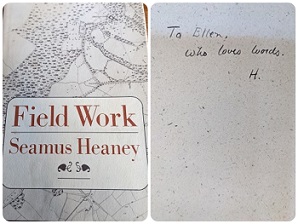
Past and present converged at a recent book event.
Golden afternoon light, voluptuous white clouds. The ominous weather-app storm warnings seemed to be wrong. At the bottom of the ridge, we turned onto the state road west to Somerset. We passed farms in the valley, climbed the mountain, passed the state prison wrapped in chain-link and barbed wire. Almost there, we followed a local lane bordered by forest.
The gracious white house appeared, anchored in a sloping green lawn with beds of bright geraniums. It felt like returning to the home of longtime friends, although I’d only been here a few times, only met our hosts four years earlier. But I’d been living in this house in my imagination for almost a decade, writing a novel set here. Today, incredibly, was the launch party for that book, Vanishing Point.
It all started with a visit to a rural art museum in the region. I fell in love with a landscape by a late 19th-century Pittsburgh artist previously unknown to me, George Hetzel, founder of the Scalp Level art colony. Intrigued, I began researching and discovered his turbulent, creative family. George died in 1899, not long after the family had moved from Pittsburgh to Somerset, to a house they called the Hetzel Studio.
His daughter, Lila, lived and painted in the studio until her death in 1967. Granddaughter Dorothy, a writer, remained there until she died in 1977. Fascinated by the creative and personal challenges faced by these women, I decided to make Lila and Dorothy my story’s primary characters. The Hetzel Studio was less than an hour from our home in Bedford County. I had to get inside.
My first attempt, on a snowy day in 2022, was a cold call in every way. I knocked; no one was home. Scribbling a note of explanation on the back of my card, I wedged it in the door jamb.
Ten days later, a text appeared: Hetzel House. Sorry. Note blew away. Found it. Just back from England.
That evening, “Hetzel House” (aka Michelle and Dan) called. Phone on speaker, I took notes. Michelle had grown up on the farm next door; as a child, she had known Dorothy. She’d always wanted to live in the house, and after medical school, she came back, bought the studio (vacant except for wild animals), and began its restoration.
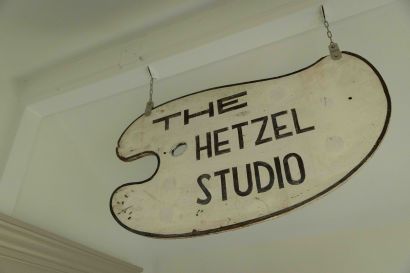
That Sunday, I returned by invitation. A sign shaped like an artist’s palette hung above the door: Hetzel Studio. “George painted that,” said Dan. We toured from cellar to attic. From Lila’s and Dorothy’s letters and diaries, I’d envisioned a darker, shabbier version of these rooms. They’d never had enough money. Now, the floors gleamed; walls glowed with soft color and period wallpaper.
Over tea and cookies in the parlor, Michelle shared albums of the long restoration process and recounted stories Dorothy had told her. Leaving to repot geraniums, she granted me free range through her archive. Dan positioned a photocopier beside the grand piano and duplicated everything I requested. Onsite-research heaven.
The next visit, a warm afternoon on the porch with hors d’oeuvres prepared by Michelle and pours courtesy of Dan, they suggested a book launch at the Hetzel Studio. Their trust in me, an inquisitive stranger, to write a good novel felt like validation.
Continuing research in libraries, museums, and historical societies throughout the region and in Pittsburgh, I wrote and revised, renaming the book three times: Scalp Level, Still Life, and Coming to Light. Finally, in May 2025, I submitted the finished manuscript, now called Vanishing Point, to my editor.
And I also sent Dan and Michelle an advance copy in late January 2026. Writing fiction, I aim for narrative truth but write it slant, as the poet said. I’d warned them, but would they remember and understand?
Hetzel House. February 11: Michelle & I took a peek at the book. First few pages in the little girl from the farm was nearly in tears.
February 15: Just finished. Tears in my eyes at the end. The characters came to life for me. The emotional connections felt deeply real.
Whew. Tears in my eyes, too.
Once the May 2026 publication date was firm, Dan began planning what became a glorious, ambitious hybrid event: a book launch and milestone birthday party for Michelle.
This past Saturday, Dan directed us to park in the garage, “You have books to bring in for the signing table.” Michelle was in the garage, apron over her party dress, tending fragrant beans in a Nesco roaster (a newer descendant of my mother’s vintage Nesco). As we unloaded books, a van from the Dressler Art Center pulled in beside us. The cargo? Three original Hetzels on loan (and insured to the gills). When Dan initially told me he’d ask about borrowing them, I’d been dubious. “All they can say is no,” he said.
We lugged the sound system onto the porch for my reading. The stage was set for a perfect summer party. Tables draped with white cloths, garden flowers in blue glass bottles, a string duo from the Johnstown Symphony tuning up.
I had a flashing image of Lila’s 1905 wedding on the lawn, the reception supper on the porch. Present and past overlapped and converged.
Guests were arriving. Michelle and Dan’s friends and family, plus my village of archivists, curators, librarians, and friends. Corks popped. The music began. An uninvited fierce wind section joined in, and torrential rain blew onto the porch. Phones buzzed, “Take Shelter!” We scrambled inside.
A falling tree brought down the power lines. But in the studio, lights stayed on — grid-free thanks to the solar panels across the road and batteries in the cellar. At least there was no need to plug in a sound system in the dining room.
The passage I’d selected to read aloud describes the Hetzels arriving at the studio for the first time, on moving day in 1898. I lost my place on the page. The lights were a little dim, but that’s not why I faltered.
It was another slipping, convergent moment. I was in the dining room now with this friendly audience. And I was also in the dining room then with George, his wife, Mary Louise, Lila, and her brothers, Jimmie and Frank.
I caught my breath and read:
“They followed Jimmie into the dining room. ‘Oh, it’s beautiful. And so long. We can keep all the table leaves in,’ said Mary Louise. ‘But where’s the kitchen?’”
Life is indeed stranger than fiction. And occasionally, more wonderful. If you ever want to throw a book party, I know a physician and a magician who do a swell job.
[Photo courtesy of WattersWorks Photography.]
Ellen Prentiss Campbell’s collection of love stories is Known By Heart. Her collection Contents Under Pressure was nominated for the National Book Award; her novel The Bowl with Gold Seams won the Indy Excellence Award for Historical Fiction. Frieda’s Song was a finalist for the Next Generation Indie Book Award, Historical Fiction. Blogging as “Girl Writing” in the Independent bi-monthly, she lives in Washington, DC. For many years, Ellen practiced psychotherapy. Her new novel, Vanishing Point, is out now.