New collections to make life more lyrical.
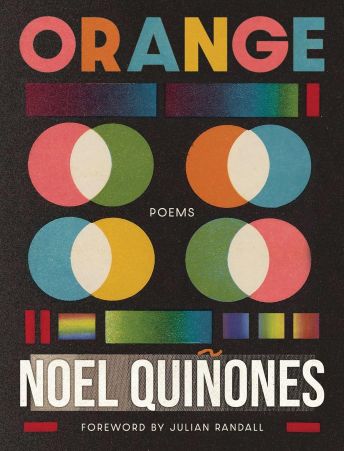
Noel Quiñones’ debut poetry collection, Orange (CavanKerry Press), is cinematic in its invitations to the reader. Visually intimate, crafting a coming-of-age narrative of a Puerto Rican family in the Bronx, this collection not only has faith in tenderness but also understands that tenderness is only the starting place for lyrical experience. For poets born within the loose range labeled as millennial (roughly 1981-1996), tenderness and pop culture often go hand-in-hand, but what Quiñones does in Orange is advance and blend those two foci into a Venn diagram where maturity sits at the center.
In the sectioned prose poem “Blockbuster Fever,” the reader experiences not only the collective euphoria of what cinema has meant to the speaker’s family, but also the verve and vigor of Quiñones’ voice:
“That unforgettable summer, Papi, Grandma, Celeste, and I went to see White Chicks at the American Theater and our chests shook like manhole covers, and our hips bent the red cushioned seats into the linchpin of laughter…”
The poem goes on to chart that moment as prying open the aperture of repressed grief over a lost loved one. A public family ritual made of unbounded expression — a kind of New Orleans second line writ small and bounded to the “line” of movie-theater seats.
The next poem, “You Sang to Me,” takes on the signifiers of learning to dance salsa, while also paying homage to the singer Marc Anthony. Cleverly, the poem visually obscures the lyrics to one of his songs with black footprints, both creating a sense of stepping on the beat or learning the steps, while also solving (quite ingeniously) a copyright conundrum that often plagues poets who want to use lyrics in their work. These types of creative presentations and solutions demonstrate how Orange centers maturity as a vector for revelation.
Maturity also appears in the book’s prismatic approach to form. There are new forms — like the duplex, invented by Jericho Brown and showcased in Quiñones’ poem “Divorce” — but also visual poems in the form of maps, poems that nod toward the color wheel and color theory, a chessboard poem, a QR-code poem, erasures, a poem in the form of a Monopoly board, and a ghazal (with “orange” as the chanted word). Again and again, a relentless curiosity is lifted up as the narrative orbits the poems’ speakers’ understanding of sexual desire, queer identity, family mythos, abandonment, and so much more.
“Is love measured by duration or depth?” the poem “Marriage” asks of itself and of us. The entire collection, in fact, turns that question inward and outward at once, moving beyond Quiñones’ autobiographical specifics to become an ars poetica prompt: Is a poem’s love measured by duration or depth?
Quiñones seems to be keenly aware of the multiple traditions their poems inhabit, and through this awareness, we readers are brought into the cinema of tenderness. Orange ends with the line, “I develop in the light,” which concludes the poem “Beyond Orange.” What is true for the poem’s speaker is also true for the reader. One will be moved, developed, and seen. And isn’t that ultimately the kind of blessing a poet wants their work to bestow?
Steven Leyva’s latest poetry collection is The Opposite of Cruelty.