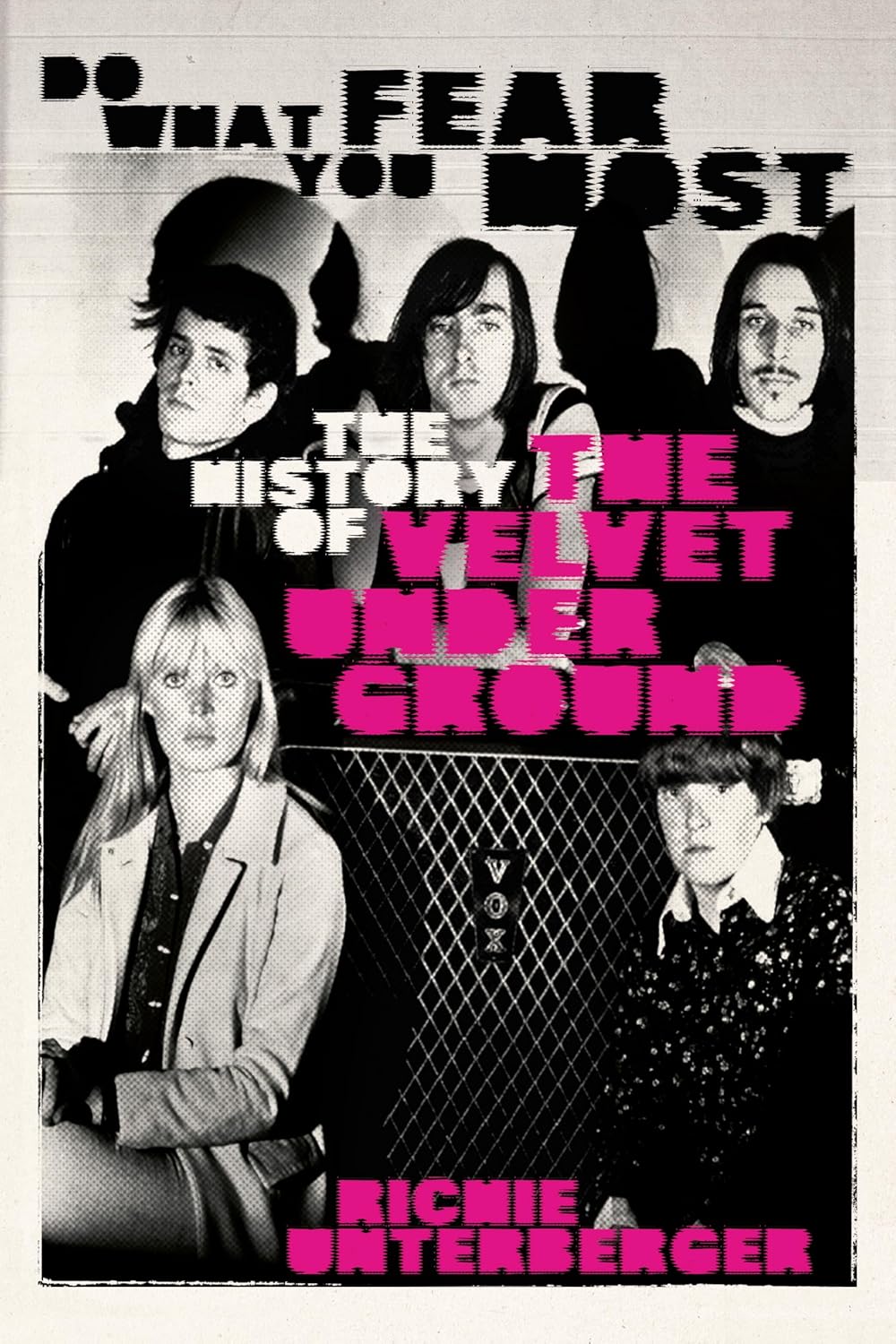
Do What You Fear Most: The History of the Velvet Underground
- By Richie Unterberger
- Omnibus Press
- 816 pp.
- Reviewed by Daniel de Visé
- July 9, 2026
An illuminating account of the band that made Lou Reed famous.
The Velvet Underground ranks among the very greatest rock ‘n’ roll bands America has produced, on par with the Beach Boys and Byrds, Grateful Dead and R.E.M.
And it was very much a band, as Richie Unterberger documents in his exhaustive new biography, Do What You Fear Most: The History of the Velvet Underground. Lou Reed is the icon, one of rock’s great songwriters, but the Velvet Underground was a group effort.
It’s about time we had a definitive biography of the band. We already have several of Reed, including recent volumes by rock-journo heavyweights Anthony DeCurtis and Will Hermes. But you could argue that they miss the point.
The Velvets produced four studio albums in their short lifetime, and all rank among the greatest recordings in the rock ‘n’ roll idiom. Even such leftovers and afterthoughts as the “lost” album, VU, and 1969: The Velvet Underground Live are essential. Reed made many solo albums between his departure from the band in 1970 and his death in 2013, and a few of them are great, but none approaches the artistry of any Velvet Underground LP.
I’d always assumed Reed wrote his best songs when he was with the Velvets, and that’s probably true. Yet, as Unterberger explains, this band exceeded the sum of its parts.
The original group comprised Reed, lead singer and (mostly) rhythm guitarist; John Cale, a Welsh-born, classically trained artiste, on electric viola, keyboards, and bass; Sterling Morrison, the nominal lead guitarist; and Maureen “Moe” Tucker, a rare and suitably androgynous woman drummer.
And then there was Nico. A former model born in Germany, Nico was never quite a band member. (Look at how the Velvets’ debut album is titled: The Velvet Underground & Nico.) Andy Warhol brought her in when he took the band under his wing, betting that her chiseled features and Teutonic drone would draw attention to the group. It worked: Early press clippings focused almost entirely on Nico, as if she were the artist and Reed and the others her backing band.
Nico also drew some of the sharpest critical barbs from writers who dug deep to find appropriately contemptuous descriptors for the band’s sound. A Detroit Free Press reporter opined that Nico “sounded like a Bedouin woman singing a funeral dirge in Arabic while accompanied by an off-key air raid siren.”
Reed, the Velvet Underground’s frontman and actual leader, apparently sketched out the lyrics and basic structure of most of the songs on the band’s debut. And then, his bandmates worked and kneaded them, adding voices and instruments and rhythms, gradually transforming them into polished gems. In purely musical terms, the best songs on the album, “Heroin” and “I’m Waiting for My Man,” are defined by how the full band performed them, or, in the case of “Femme Fatale” and “I’ll Be Your Mirror,” how Nico sang them.
“The publishing company was called Three Prong because there were three of us involved,” Morrison said in a 1981 interview, referring to himself, Reed, and Cale. “I’m the last person to deny Lou’s immense contribution, and he’s the best songwriter of the three of us. But he wanted all the credit, he wanted it more than we did, and he got it, to keep the peace.”
(For balance, I should add that Nico emerged as a fine songwriter in her own right after she left the Velvet Underground.)
Unterberger makes an even stronger case for the Velvet Underground as a collective endeavor with its second album, White Light/White Heat — it’s a deranged performance more than a set of songs. The words and chords were largely Reed’s, but the inimitable sound belonged to the band: Cale’s throbbing viola; Tucker’s pounding war drums; and Reed’s manic, “Eight Miles High”-inspired leads. “I knew that there was a really original, dirty, unhealthy, indecent style,” Cale observed.
Nico departed after the first album, Cale after the second. Why did Reed fire him? Cale’s ideas were too out-there. He was a profligate spender. He didn’t want to be a sideman in his own group. He looked too good on stage. Unterberger spent years on his book, reading everything and interviewing everyone, and he airs every theory on every plot twist in the Velvet Underground story. Most of the time, you don’t get a clear-cut answer because there isn’t one.
The second half of the Velvet Underground’s brief career was more or less defined by Cale’s replacement, Doug Yule. He was a “facilitator,” by his own admission. Like Cale, Yule could play just about every instrument, and he could sing. Unlike Cale, Yule was happy in the role of sideman, at least for a while.
Liberated from the avant-garde impulses of Warhol and Cale, Reed was free to write and record pop albums. The band’s eponymous third LP was perhaps the purest expression of Reed’s songcraft. Critics loved it. Almost no one bought it.
The gang tried one last time with Loaded, a collection of songs seemingly selected, arranged, and recorded to suit the FM-radio gods. Tucker (along with her thundering drums) was curiously absent from the sessions, ostensibly on maternity leave. Sweet-voiced Yule sang lead on several songs, supposedly because Reed had blown his vocal cords out. Several terrific compositions — “Ocean,” “Satellite of Love,” and “Lisa Says” — were passed over in favor of lesser cuts that sounded more like FM radio in 1970.
Did Reed really blow out his voice? Was Tucker really unavailable? Had the Velvet Underground been reduced to a Lou Reed cover band, with Reed complicit in the subversion? Unterberger lays out all the theories and leaves the reader to do the math.
Two songs on Loaded, “Sweet Jane” and “Rock & Roll,” were probably the best things Reed ever wrote, and both should have been hits. They weren’t, and by the time Loaded hit stores, Reed had left the band.
Do What You Fear Most isn’t for everyone. It’s certainly not for readers who want dirt on Warhol and Edie Sedgwick and the Factory and the Scene. For them, reading Unterberger’s book will be akin to watching “Chelsea Girls” in its entirety.
Nor is this book for casual consumers of rock biographies. It’s 800 pages long. If you want the 400-page version, buy the Dylan Jones biography instead.
Unterberger attributes every quote right in the text, which is annoying. He covers every step in the band’s journey from every conceivable angle. He delivers critical appraisals of seemingly every song on every obscure demo and fan tape. Reed apparently never performed “Sister Ray” the same way twice, and in this book, you’ll hear about every variant: Unterberger mentions the song 93 times.
Therein, perhaps, lies a limitation of rock-band biographies. A rock musician’s life plays out as a monotonous procession of shows, punctuated by the occasional recording session, album release, and rehab stay. If you purchase Do What You Fear Most expecting a well-paced narrative and a View-Master reel of the subject, be prepared to do some skimming. This is a book for hardcore fans, and we are many.
Daniel de Visé is the author, most recently, of The Blues Brothers: An Epic Friendship, the Rise of Improv, and the Making of an American Film Classic.